The runaway pancake: an Asbjørnsen tale with the pig at the brook
A pancake runs away from a woman, her husband and seven children and rolls down the road. See the plot of the Norwegian tale collected by Asbjørnsen, the animals it meets and the pig at the brook, and what remains uncertain.
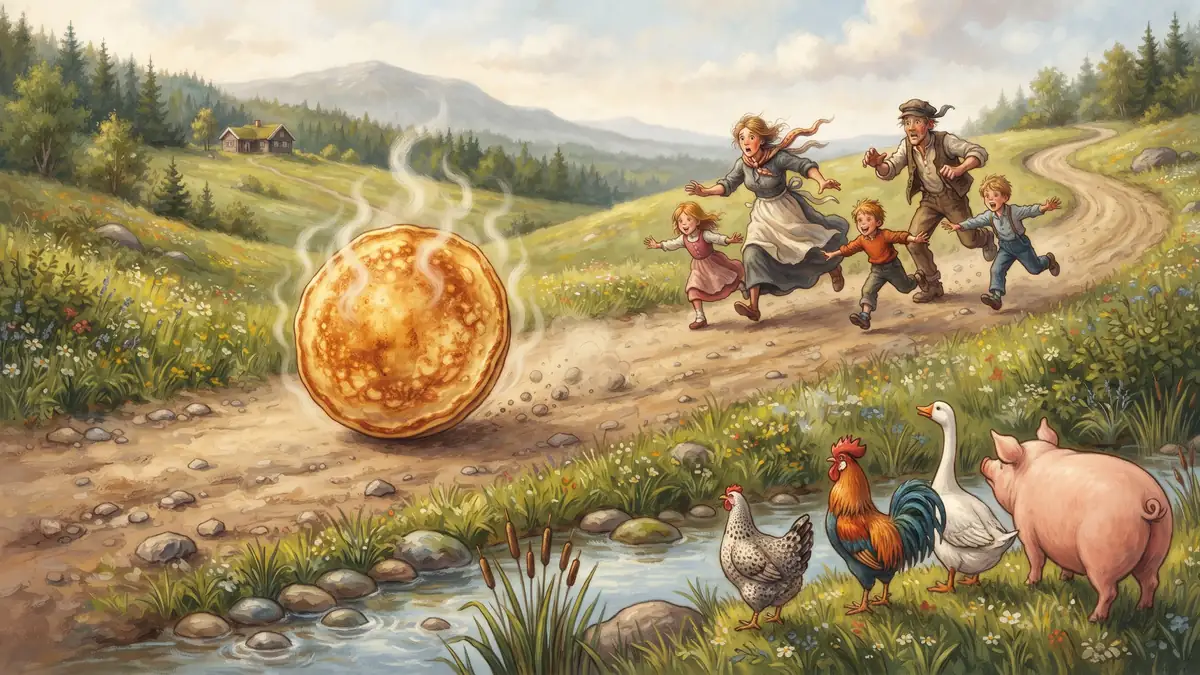
Few folktales have a hero as simple as a pancake. The plot fits in one sentence: it escapes from the frying pan, runs away from everyone and ends badly. Even so, this tale, which Peter Christen Asbjørnsen collected in Norway, shows well how a story for children is built from repetition.
In the kitchen
In George Webbe Dasent’s English translation, the tale begins with a woman frying a sweet-milk pancake while her seven hungry children and her husband watch. The children beg for a piece with ever-grander praise. The woman tells them to wait until the pancake turns itself. The pancake takes fright, turns over by itself and leaps from the pan onto the floor.
The flight down the road
The pancake goes out the door and rolls down the hill like a wheel. The woman, the children and the husband run after it shouting for it to stop. On the road it meets a man, a hen, a cock, a duck, a goose and a gander. All ask it to stop so they can eat it. It refuses each one with the same rhyme: before speaking to the next, it recalls that it has already given the slip to the woman, the husband, the seven children and every earlier animal, and the list grows with each meeting.
The pig and the brook
The last is the pig, who does not try to eat it. He suggests they travel together through the wood, where it is not safe to walk alone. The pancake agrees. When they reach a brook, it cannot cross, but the pig is fat and can swim. He offers to carry it on his snout, and as soon as it climbs up, he swallows it in one gulp, with an “ouf, ouf”. The narrator closes by saying the story can go no farther.
A tale of accumulating flight
The structure is one of growing repetition: each meeting adds a name to the list of those outwitted, and the child listening learns to wait for the phrase before it comes. The ending is a surprise, because the only character who does not attack is the one who eats. Tales of accumulating flight exist in many European traditions, and the collection of Asbjørnsen and Moe, together with Dasent’s in English, helped spread such plots.
In short
A pancake runs from the frying pan, escapes a family and six animals with the same rhyme and is swallowed by a pig while crossing a brook. The tale is in Asbjørnsen’s Tales from the Fjeld, in Dasent’s translation.
Terms
An accumulating-flight tale is one in which a fugitive escapes a growing number of pursuers. Dasent is George Webbe Dasent, the English translator of the Norwegian tales. Fjeld is the Norwegian mountain plateau.
What remains uncertain
We do not know how the tale circulated orally before Asbjørnsen. The funny names of the animals, in the English version, are translation choices, and the original Norwegian version has its own names and rhymes.
To dodge the animals on the road and keep the pancake rolling, play Down the hill.
Sources.
- Peter Christen Asbjørnsen, Tales from the Fjeld, translated by George Webbe Dasent (Project Gutenberg, ebook 36385)
- Wikipedia, "Norwegian Folktales"