Bryggen: the rune sticks of Bergen, merchants' notes and love charms
Since 1955, about 670 medieval runic inscriptions have been found at Bryggen, in Bergen. See the sticks with owners' names, messages, Latin prayers and love charms, and what is still debated.
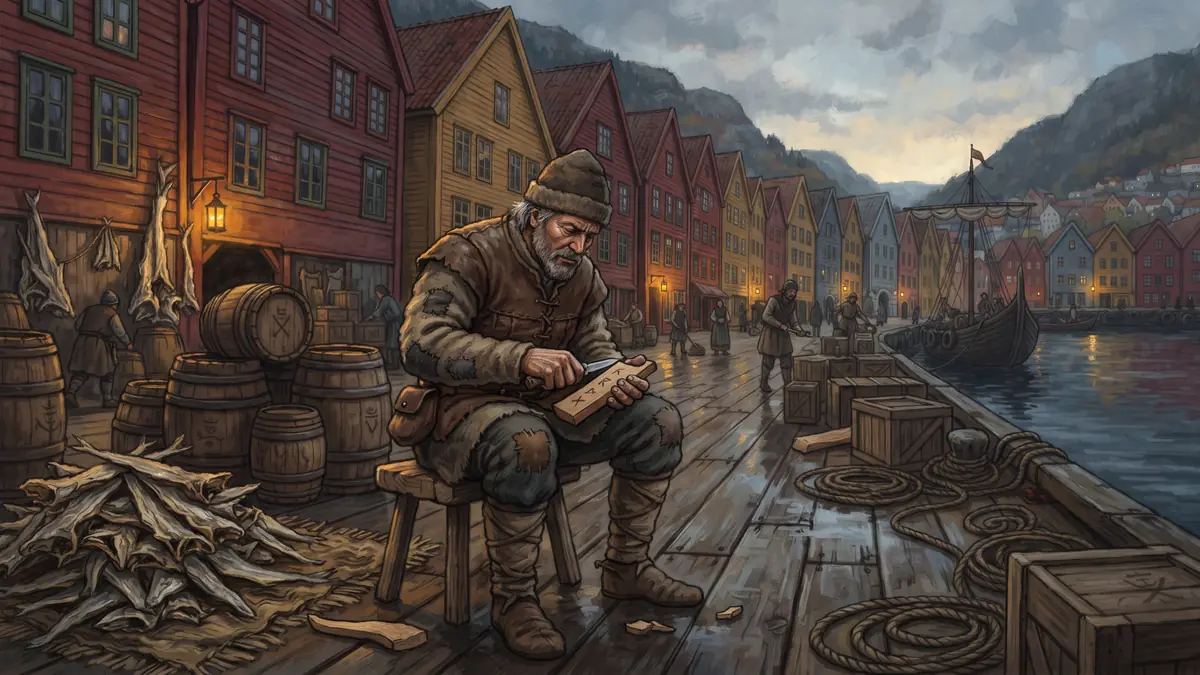
When people speak of runes, the usual image is of a stone raised by a Viking king. In Bergen, reality was far more everyday: a wharf full of merchants scratching messages, names and prayers on pine sticks. The inscriptions of Bryggen, found from 1955, show a Norway that used runic writing in daily life long after the Viking Age.
What was found
Since 1955, about 670 medieval runic inscriptions have been discovered at Bryggen and nearby sites in Bergen. Most are on pine, but there is also bone, such as a walrus skull, and objects such as a wooden cylinder, a cross, the bottom of a bowl and even a shoe. Many date to at least the fourteenth century, which contradicted the belief that the use of runes in Norway had ended much earlier. They are now in Bryggens Museum, in Bergen, with some pieces on display.
Names, messages and business
The formula “Eysteinn á mik”, “Eysteinn owns me”, works as a name tag. Among the messages are everything from commercial requests and orders, in longer texts, to the phrase “Ást min, kyss mik”, “my love, kiss me”. One inscription says “Gyða segir at þú gakk heim”, which the source translates as “Gyða tells you to go home”. A secret message on a wax tablet urges someone to switch sides in a civil war.
Prayers and charms
There are also religious and magical texts. Short inscriptions in Latin, such as “Ave Maria”, may have served as amulets. One cites the Norns and carries a stanza in dróttkvætt and a line from Virgil. Another is a love charm similar to the curse in the Eddic poem Skírnismál. Another invokes Thor and Odin, which shows that old names were still remembered.
A voice of everyday life
The value of these sticks lies in their being texts of ordinary people, with no pretension of monument. They show that merchants knew how to write in runes, mixed Old Norse with Latin and used writing for everything, from trade to flirtation.
In short
At Bryggen, Bergen, about 670 medieval runic inscriptions were found, among them owner tags, business messages, Latin prayers and charms. They show everyday use of runes centuries after the Viking Age.
Terms
Bryggen is the old merchants’ waterfront of Bergen. Dróttkvætt is the refined metre of skaldic poetry. A wax tablet is a wooden board covered with wax, used for writing.
What remains uncertain
The dates of many inscriptions are approximate, and some are so short or damaged that the reading is disputed. We do not know who wrote each stick, and whether pieces such as the love charm relate to real magical practices or only literary ones remains debated.
To sort each rune stick into the right box, play The rune sticks.
Sources.
- Bryggens Museum, Bergen (runic inscriptions from Bryggen)
- Medievalists.net, "The Runes of Bergen: Voices from the Middle Ages"
- Wikipedia, "Bryggen inscriptions"