The Kingittorsuaq runestone: three Norsemen and three piles of stones in Greenland
In 1824 a stone with runes was found on an island in northern Greenland naming three men and three piles of stones. See the text, the approximate date, the six runes nobody can read and what remains uncertain.
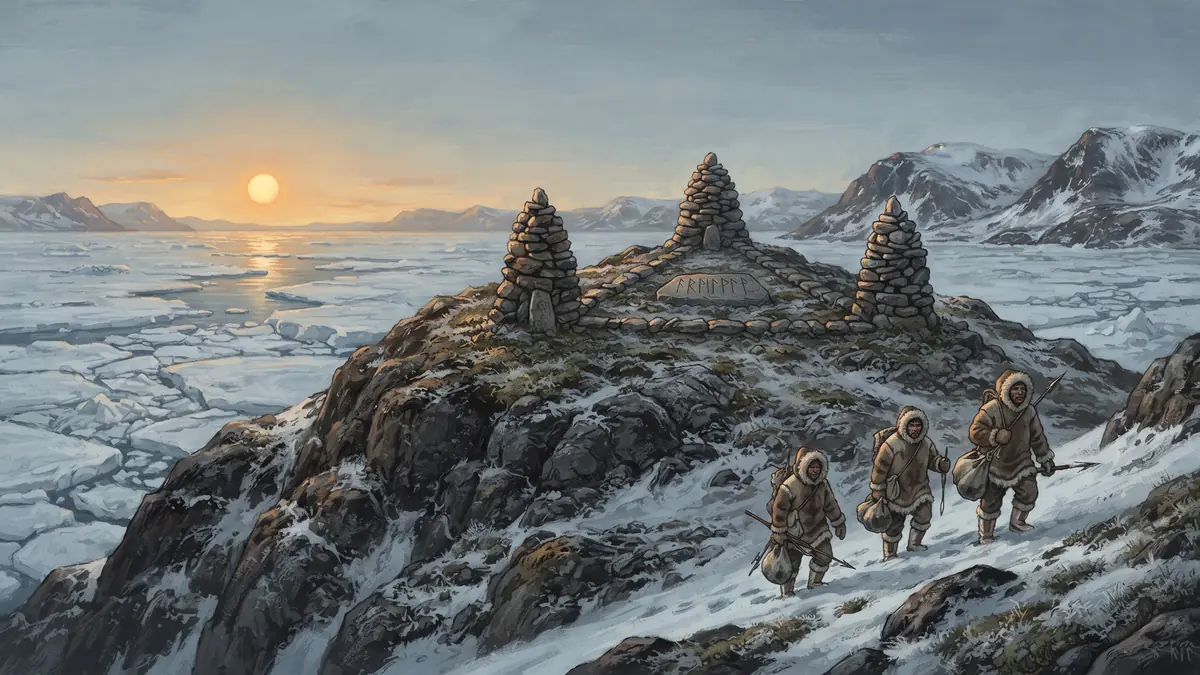
Almost all Norse runestones are in Scandinavia, but one of them lies much farther away: on top of an island in northern Greenland, among piles of stones. The Kingittorsuaq stone is one of the few written signs the Norse left so far from home, and it still holds a passage that nobody can read.
Where and when it was found
The stone was found in 1824 on the island of Kingittorsuaq, in the Upernavik archipelago, in northwest Greenland. It lay in a group of three piles of stones, or varðar, which formed an equilateral triangle on the top of the island. Today it is kept in the National Museum of Denmark, in Copenhagen.
What the inscription says
The text names three men: Erlingr Sighvatsson, Bjarni Þórðarson and Eindriði Oddsson. It says they built these cairns on the Saturday before Gagndagr, the “procession day”, or Rogation Day, and then comes a passage that is partly undeciphered. The writing is in medieval runes, with bind runes, in which a single sign combines two letters, as in the sequence ar.
The date
The stone is dated to the Middle Ages, generally around 1300. Other proposed dates range from 1250 to 1333. The historian Finn Gad observed that the date can be read in various ways and that, for this reason, it does not prove that the three hunters spent the winter there.
The six runes nobody reads
The last six runes remain undeciphered, and every scholar has proposed something. Rasmus Rask, in 1824, thought they encoded the year. Finnur Jónsson, in 1914, took them for ornament or magical signs. Magnus Olsen, in 1932, suggested the last word was rýndu, “wrote runes”. Fritz Läffler, in 1906, read ruddu and the magic word ís, “ice”, in the sense of “cleared the ice”. William Thalbitzer, in 1951, joined the two ideas in ok rýndu ís. In 1967, Alf Mongé proposed that the runes held two sets of ciphers, one for a date and one for the carver’s name, but Mindy MacLeod, in 2002, found little or no evidence that bind runes were used for numerical magic.
In short
The Kingittorsuaq stone, found in 1824, records that three Norsemen made three piles of stones on an island in northwest Greenland, around 1300. The final six runes remain unread.
Terms
A varða (plural varðar) is a pile of stones used as a marker. A bind rune is a sign that joins two letters. Gagndagr is procession day, tied to the Christian Rogation days.
What remains uncertain
We do not know what the last runes say, or whether the date was written in cipher. The source consulted also does not say who found the stone, and the context of what the three men were doing so far north is, in good part, deduction.
To stack the stones without letting the tower fall, play The three cairns.
Sources.
- Runic inscription of Kingittorsuaq (National Museum of Denmark)
- Finn Gad, The History of Greenland (context of the Norse)
- Wikipedia, "Kingittorsuaq Runestone"