Sneglu-Halli: the sharp-tongued Icelander at the court of Harald Hardrada
Sneglu-Halli, "Sarcastic Halli", is an Icelandic poet who teases King Harald in Norway. See the porridge, the roast pig, the silver with tar and the debates over what the tale says about the king, and what remains uncertain.
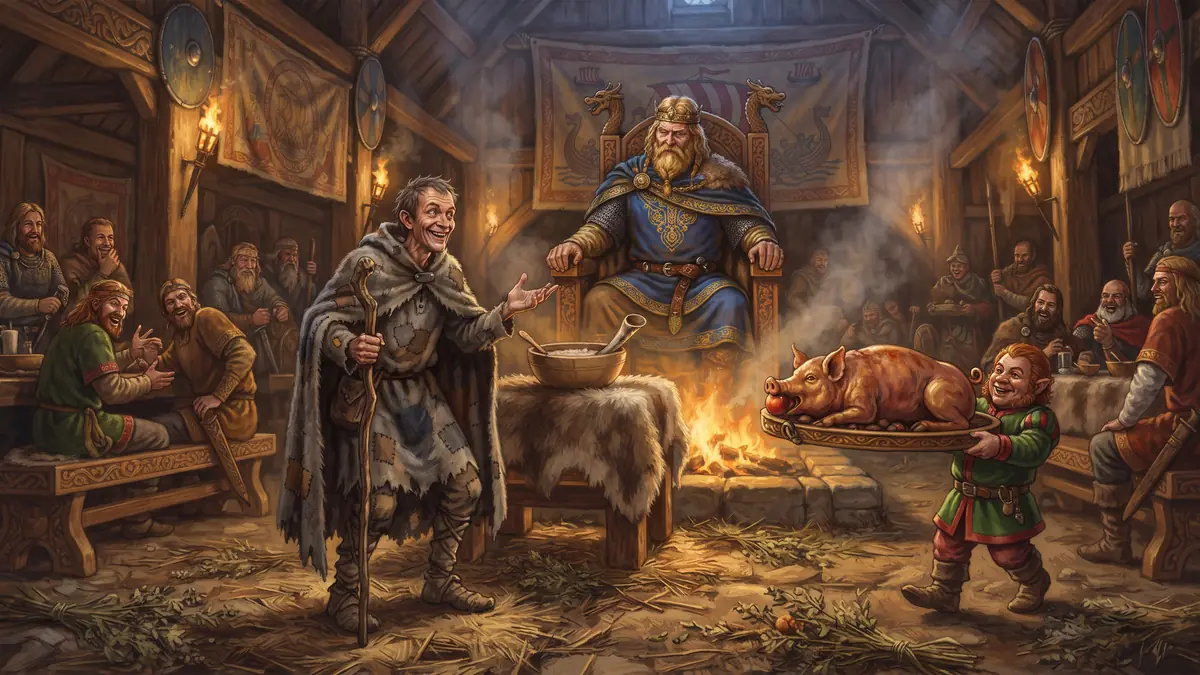
When an Icelandic poet came to the court of the king of Norway, he was expected to be polite. Halli did the opposite. The Sneglu-Halla þáttr, “the tale of Sarcastic Halli”, shows how a sharp-tongued outsider manages to stay in the house of Harald Hardrada without losing his head or his good humour.
A short tale, two versions
A þáttr is a short Icelandic tale, often embedded in larger works. This one survives in two manuscripts: in Morkinskinna, a subtler and less explicit version, and in Flateyjarbók, a longer and more direct version, on which the English translation is based. Both tell how Halli enters Harald’s service and makes humour his weapon.
The king’s porridge
Halli rivals Thjodolf, the court master-poet, and quickly composes an insulting verse about the king’s dwarf. He also criticises Harald’s way of eating, which is to serve himself first and have the food cleared before the others are full. The king confronts him over a bowl of porridge and sentences him to eat it until he bursts or be beheaded. Halli is not intimidated and calls the bluff, and the king backs down.
The roast pig
In another scene, the king demands a poem before the dwarf may bring in a roast pig, and Halli recites it successfully. Thjodolf accuses him of lying about his poem, and the two enter a senna, the ritual exchange of insults. Halli wins. In Denmark, he tricks a man named Raud out of a gold arm ring, and when the Danish king offers to pour silver on his head and let him keep what sticks, Halli puts tar in his hair so that the silver sticks.
What the tale says of the king
Scholars disagree. Hannon (2010) reads the tale as proof of Harald’s affection for Icelanders, poets and coarse humour, even when he is the target. Tirosh (2017) disputes this: for him, scenes such as the axe episode show the king’s growing contempt for poets in old age. Others use the text to study skaldic poetry, which described mundane scenes in mythic language to insult without losing prestige.
In short
Sneglu-Halli is a thirteenth-century Icelandic tale about a poet who uses humour to stay at the court of Harald Hardrada. It survives in Morkinskinna and Flateyjarbók, and its reading remains debated.
Terms
A þáttr is a short Icelandic tale. A senna is the ritual contest of insults. A skald is the court poet. Harald Hardrada is the Norwegian king who died at Stamford Bridge.
What remains uncertain
There is no way to know whether Halli existed as a person or how much of the tale reflects Harald’s real court. The two versions differ, and the reading of the king’s tone, between affection and contempt, depends on the manuscript and the scholar.
To return each insult at the right moment, play The comeback.
Sources.
- Sneglu-Halla þáttr, in Morkinskinna and Flateyjarbók
- Heimskringla, Haralds saga Sigurðarsonar (background to the reign)
- Wikipedia, "The Tale of Sarcastic Halli"