Brand the Generous: the Icelander who gave a cloak, an axe and half a tunic to King Harald
In the short tale "Brands þáttr örva", an Icelander yields to the king of Norway, without a word, a cloak, an axe and a tunic. See the king’s test, the gesture of the sleeve and where the text comes from.
The Icelanders who went to Norway in the sagas usually take goods and come back with stories. In Brands þáttr örva, a þáttr, or short tale, what is told is a test of generosity. King Harald wants to know whether an Icelander’s fame is true, and the answer comes without words. I read the text in Eiður Eyþórsson’s translation.
The Icelander and the poet
Brand is an Icelander known as “the Generous” and the son of Vermund of Vatnsfjord. One summer, he sails from Iceland to Norway and docks at Nidaros. His friend Thjodolf, a poet, had already told King Harald how generous and magnanimous Brand was. The king decides to put the reputation to the test.
The three requests
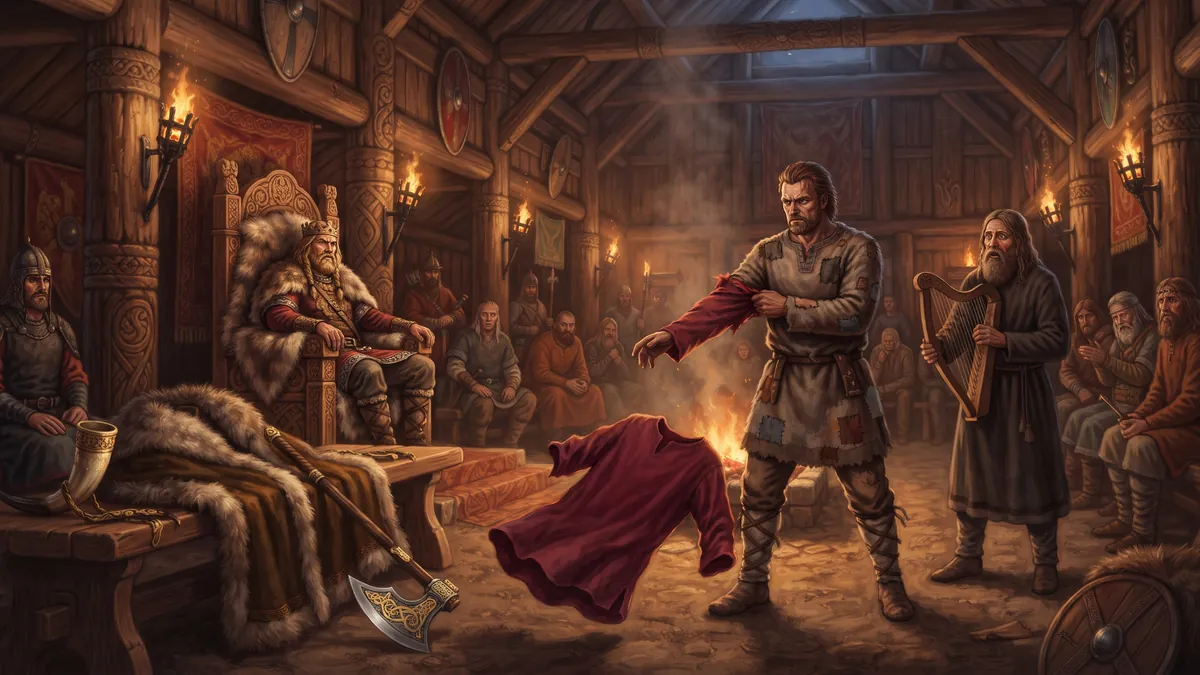
The king makes three requests, all delivered by Thjodolf. The first is the cloak Brand is wearing: he says nothing and lets it slip off his shoulders. The second is the axe inlaid with gold: Brand hands it over in silence, and the king remarks that he “gives wealth now without restraint”. The third is the tunic: Brand takes it off, tears off one sleeve, throws the rest away and keeps the other sleeve.
The gesture of the sleeve
The king reads the gesture as a rebuke. In the words of the text, it seems to him that Brand thinks he has one hand, and that this hand serves only to receive and never to give. The sleeve Brand keeps is the tale’s most direct argument: a king who only asks must also give.
The end of the test
The king concludes that Brand is wise and great-minded, shows him great honour and gives him gifts. The tale describes this as the way Brand was put to the test.
Why the tale matters
The tale is short and has almost no action besides the three requests, and for that very reason it shows well how Icelanders imagined the relation between a king and a foreigner: the king has the power, but the visitor has the word and the freedom to answer with a gesture. The translation used is the one available on the We Vikings site, based on several manuscripts.
In short
In a few lines, the tale shows a king who tests an Icelander’s generosity and, receiving silence and a torn sleeve as an answer, understands that he must also give. The king’s gift closes the circle.
Terms
A þáttr is a short Icelandic tale, often inserted in a larger saga. Morkinskinna is a compilation of stories of Norwegian kings. Nidaros is medieval Trondheim.
What remains uncertain
The tale is a literary narrative, and the sources I read do not say whether the episode really happened. The page I consulted also does not say which saga or exact date it comes from beyond naming Morkinskinna as its base. I did not confirm who the poet Thjodolf was beyond what the tale tells.
To give the king what he asks for before time runs out, play What the king asks.
Sources.
- Brands þáttr örva ("The Tale of Brand the Generous"), translation by Eiður Eyþórsson for We Vikings, based on Morkinskinna (GKS 1009 fol.), Hulda (AM 66 fol.) and Hrokkinskinna (GKS 1010 fol.), edition by Einar Ól. Sveinsson, Íslenzk fornrit IV
- Morkinskinna, Icelandic manuscript of the thirteenth century, where the tale is preserved