Gautrek and the miserly family: the saga behind the Swedish "ättestupa"
In the saga of Gautrek, a stingy family kills itself, one by one, over trivial losses. Centuries later, Swedes gave the name "ättestupa" to cliffs. See what the saga tells and what historians say.
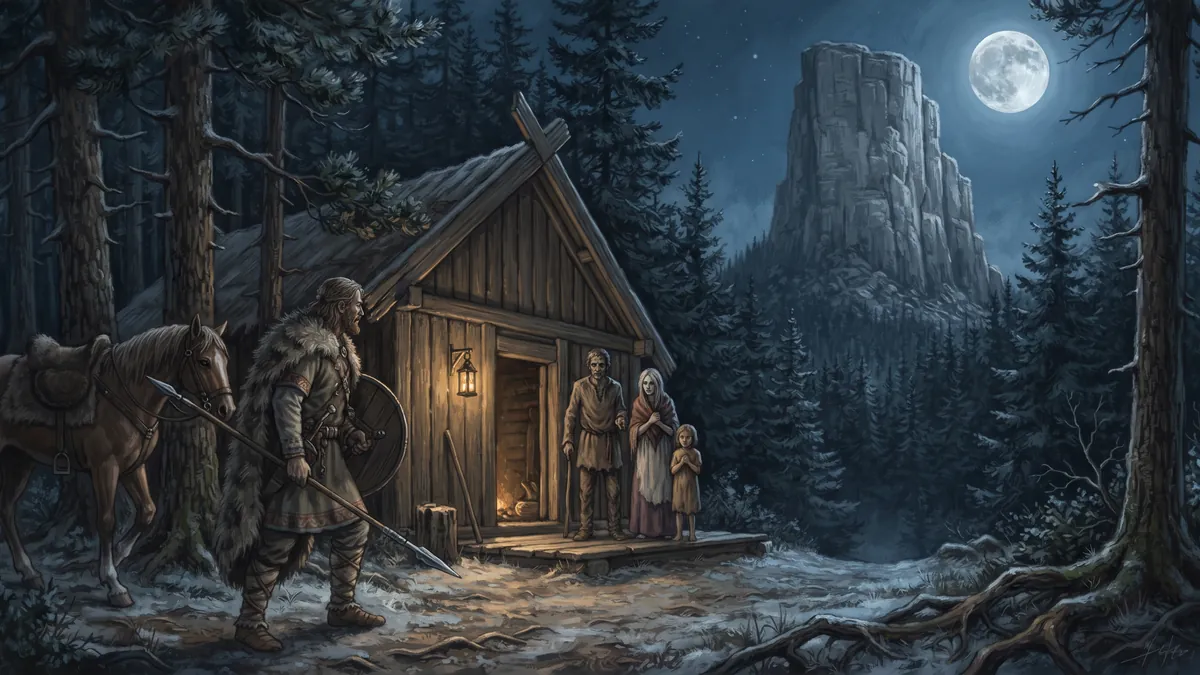
Some cliffs in Sweden carry the name ättestupa, and the most repeated idea is that the ancients made old people jump from them. The word, however, comes from a humorous Icelandic saga, and historians agree that the custom never existed. The saga in question is Gautreks saga, written at the end of the thirteenth century and preserved in much later manuscripts.
The king who got lost
The part that matters here is called Dalafífla þáttr, “the tale of the fools of the valleys”. King Gauti of West Götaland gets lost on a hunt and spends the night at an isolated house. There lives the stingy farmer Skafnörtungr, “Skinflint”, with his wife Tötra, “Tatters”, three sons and three daughters. That night, Gauti fathers Gautrekr on Snotra, the eldest daughter, considered the most intelligent of the family.
The family cliff
The family kills itself, one by one, over trivial losses, expecting to reach Odin’s Valhalla. Only Snotra and the infant Gautrekr survive. The saga calls the place Ættarstapi, “family cliff”, a word that appears in no other Old Norse text. Snotra takes her son to Gauti’s court, and on his deathbed Gauti names him heir.
From saga to map
The saga was translated into Swedish in 1664, in the edition by Olaus Verelius. From then on, Swedish antiquarians began labelling inland cliffs as ättestupa, among them the one at Omberg, in Östergötland. The linguist Adolf Noreen began questioning the myth at the end of the nineteenth century. Birgitta Odén, in 1996, and Jonathan York Heng Hui’s thesis, in 2018, are today’s references for saying that the practice never existed. The film Midsommar (2019) shows a ceremony of this kind.
The tone of the saga
It is important to remember the tone of the passage: the saga tells it as black humour, with names like “Skinflint” and “Rags” that already warn the reader that this is not an account of customs. Read that way, the family cliff is a comic exaggeration about miserliness, not the description of a practice.
In short
The ättestupa is a literary invention that became landscape: it was born as a macabre joke in a saga about stinginess and gave names to real cliffs. The same saga also contains the tale of the young Refr, who wins an earldom and a wife by trading gifts.
Terms
Ættarstapi is the “family cliff”, in Old Norse. A þáttr is a short Icelandic tale. A legendary saga is a saga that mixes ancient heroes and fantasy.
What remains uncertain
I cannot say, from these sources, who wrote the saga or where the idea of the stingy family came from. I also do not know whether the medieval authors knew of any similar real custom, and specialists say the custom of the ancient Swedes has never been proved. The manuscripts that preserve it are late, and the text exists in two versions.
To separate what is in the saga from what came later, play What is in the saga.
Sources.
- Gautreks saga (short and long versions), preserved in late manuscripts; text written at the end of the thirteenth century
- Birgitta Odén, "Ättestupan: myt eller verklighet?", Scandia 62 (2), 1996
- Jonathan York Heng Hui, "The Matter of Gautland", PhD thesis, University of Cambridge, 2018