Hacon Grizzlebeard: the Norwegian tale of the proud princess and the beggar who was a prince
A princess who scorns every suitor ends up married to a beggar. See the tale "Hacon Grizzlebeard", by Asbjørnsen and Moe, step by step, and why it is read with unease today.
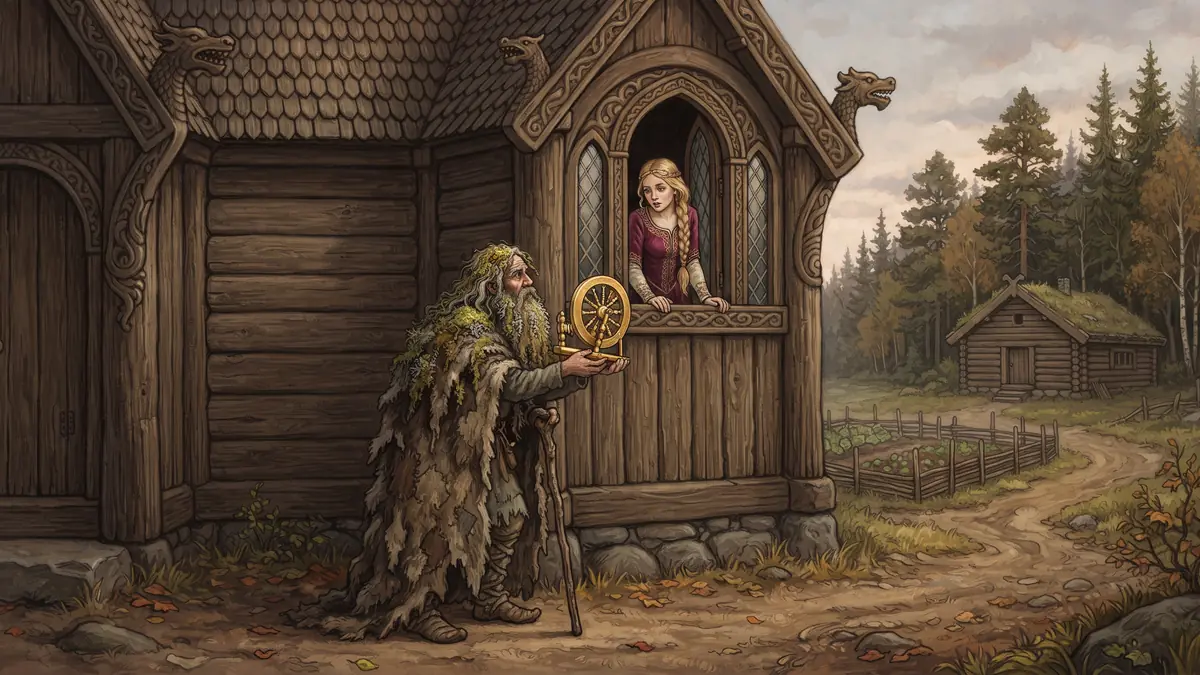
There are tales in which the moral comes wrapped in humiliations, and “Hacon Grizzlebeard” is one of them. Peter Christen Asbjørnsen and Jørgen Moe included it among the Norwegian tales, and George Webbe Dasent translated it into English. I read it in that translation. It is the story of a princess so proud that no suitor is good enough for her.
The princess who mocks
The princess is so haughty and pert that she scorns every suitor and sends them away, although many keep coming, because she is beautiful. One day Prince Hacon Grizzlebeard arrives. On the first night, she has the king’s fool cut one ear off one of his horses and slit the other’s cheeks up to the ears. In the morning, she laughs at him from the porch, blaming “the keen north wind”, and slams the door.
The disguise and the three bargains
Hacon vows revenge. He dresses as a beggar, with a moss beard and a fur cloak, buys a golden spinning wheel and stands under her window. The princess buys the wheel in exchange for leave to sleep outside her room, and he shivers with cold and cries “Hutetutetutetu!”. The next day he comes back with the stand for the wheel and trades it for a night on the floor of her room. Then he offers a golden wool-winder for resting his head on her bedstead. She ends up with a child, and the king, furious, nearly kills mother and baby.
The exile
The beggar appears in the kitchen, and the princess, cast out by her father, follows him. On the way they pass lands that she admires, and she wishes she had chosen their owner. At a palace, he builds a log cabin and works for the cook, and she is sent to the palace kitchen. There she steals bread, sausages and scraps of the wedding gown, always at her husband’s urging, and is forgiven “for the beggar’s sake”.
The pretend bride
At last she is dressed as the bride to stand in for the sick bride. In the middle of the dance, she sees the cabin on fire and cries out for “the beggar and the babe”. Hacon declares: “Here is the beggar, and there is the babe, and so let the cabin burn away.” She recognizes him, and the merriment begins in earnest.
In short
It is a tale of pride punished by disguise and humble work, with typical repetitions: three bargains, three thefts, a cabin that burns at the end. Similar tales circulate elsewhere in Europe, such as “King Thrushbeard”, from the Brothers Grimm.
Terms
A wool-winder is an object on which thread is wound. The king’s fool is the servant who entertains the court. Hutetutetutetu is the sound of shivering with cold in the tale.
What remains uncertain
I read the tale in English and not in the Norwegian original, and the passage I consulted does not say where Asbjørnsen and Moe took it from. Many readers today find it strange that the “lesson” given to the princess is a series of humiliations, and the tale does not explain why Hacon chooses that path.
To repeat the order of the three golden bargains of the disguise, play The three trades.
Sources.
- Peter Christen Asbjørnsen and Jørgen Moe, Norwegian folk tales, translated by George Webbe Dasent, "Popular Tales from the Norse" (Project Gutenberg no. 8933): "Hacon Grizzlebeard"
- Peter Christen Asbjørnsen and Jørgen Moe, Norske Folkeeventyr (collection of tales gathered in the nineteenth century)