Hjúki and Bil: the children who follow the Moon carrying a pail in the Edda
In the Prose Edda, Máni takes two children from the earth who carry a pail on a pole. See what Snorri says about Hjúki and Bil, the Moon and the Sun, and what he does not say about the spots on the Moon.
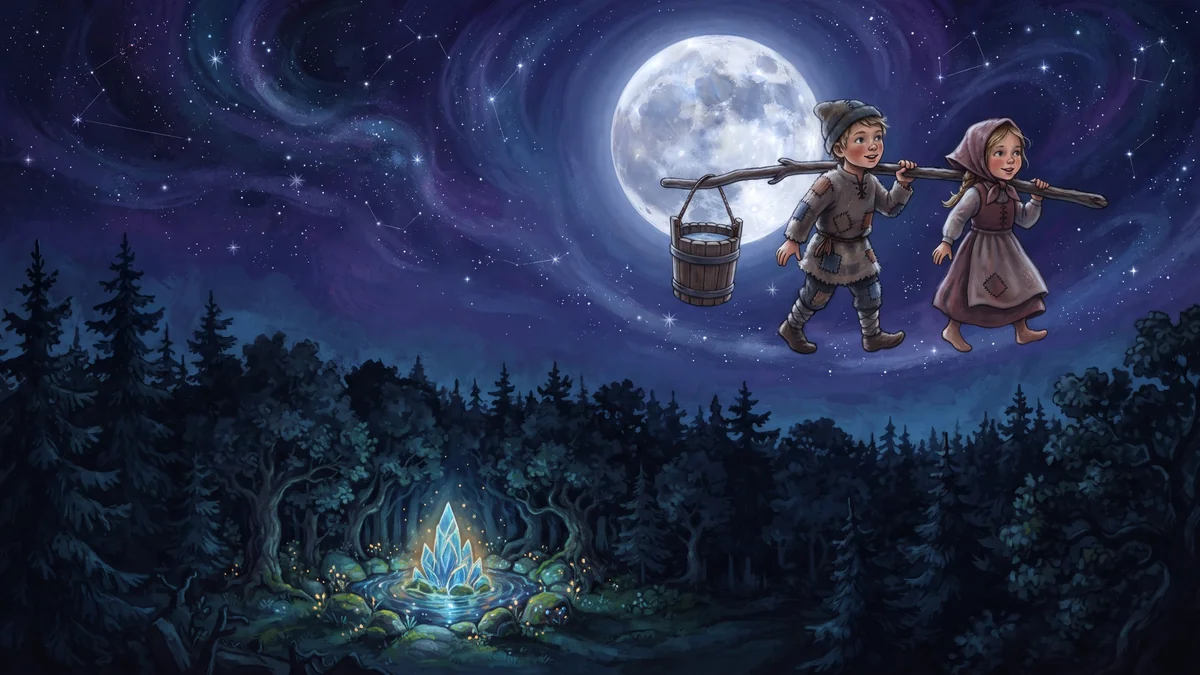
When Snorri tells how the Sun and the Moon came to travel across the sky, he mentions a third pair: two children who follow the Moon. Their names are Hjúki and Bil, and the text is short. It is worth reading slowly, because much of what is repeated about them today is not in it.
The siblings of the sky
In Gylfaginning, chapter 11, Snorri tells that a man named Mundilfari had two children, the Moon (Máni) and the Sun (Sól). The translation I consulted calls the Moon “Moon” and ties the two to the movement of the heavenly bodies: the Moon steers the course of the moon and decides when it waxes and wanes. The passage treats the Moon as a male figure, which fits the Norse name Máni, and the Sun is his sister.
The two children
After recalling who steers the sky, the text says that the Moon took two children from the earth, named Bil and Hjúki, who were coming from the well called Byrgir. They carried on their shoulders the cask called Sægr, hung on the pole called Símul. Their father was named Viðfinnr. And Snorri concludes: these children follow the Moon, “as may be seen from the earth”.
Is there a man in the Moon?
It is common to read in this passage an explanation for the spots on the Moon, as if Hjúki and Bil with the pail were the picture one sees. But Snorri’s text does not say this. It says only that the children accompany the Moon and that this can be seen from here. Whoever links the scene to the lunar spots is making an interpretation that is not in the sentence.
Where the passage appears
The passage sits inside a larger explanation of the course of the heavenly bodies. Right after it, the same chapter speaks of the wolves that chase the Sun and the Moon, so the children are only one detail in a longer description of the march of the sky.
In short
Snorri presents Hjúki and Bil as children taken from the earth by Máni, who walk behind the Moon with a cask on a pole. The text is a sentence and a half long, and it gives the names of the father, the well and the objects.
Terms
Máni is the Moon, in Old Norse. Sól is the Sun. Byrgir is the well the children came from. Sægr is the cask and Símul is the pole it is carried on.
What remains uncertain
Snorri does not explain why the Moon took the children, or whether they went to the sky willingly. He also does not say that the figures are visible on the Moon’s surface, and the sources I read do not confirm the reading of the spots. What the text states clearly is only the list of names and the sentence that the children follow the Moon.
To choose the phase of the moon that comes next, as Máni steers its waxing and waning, play The phases of the moon.
Sources.
- Snorri Sturluson, Prose Edda (Gylfaginning, chapter 11, "Of Sól and Máni")
- Prose Edda, Gylfaginning, English translation consulted at voluspa.org