The Twelve Wild Ducks: the Norwegian tale of the sister who could not speak, laugh or weep
Twelve princes turn into wild ducks and their sister must make twelve shirts without speaking, laughing or weeping. See the tale by Asbjørnsen and Moe, as Dasent translated it, and what remains uncertain.
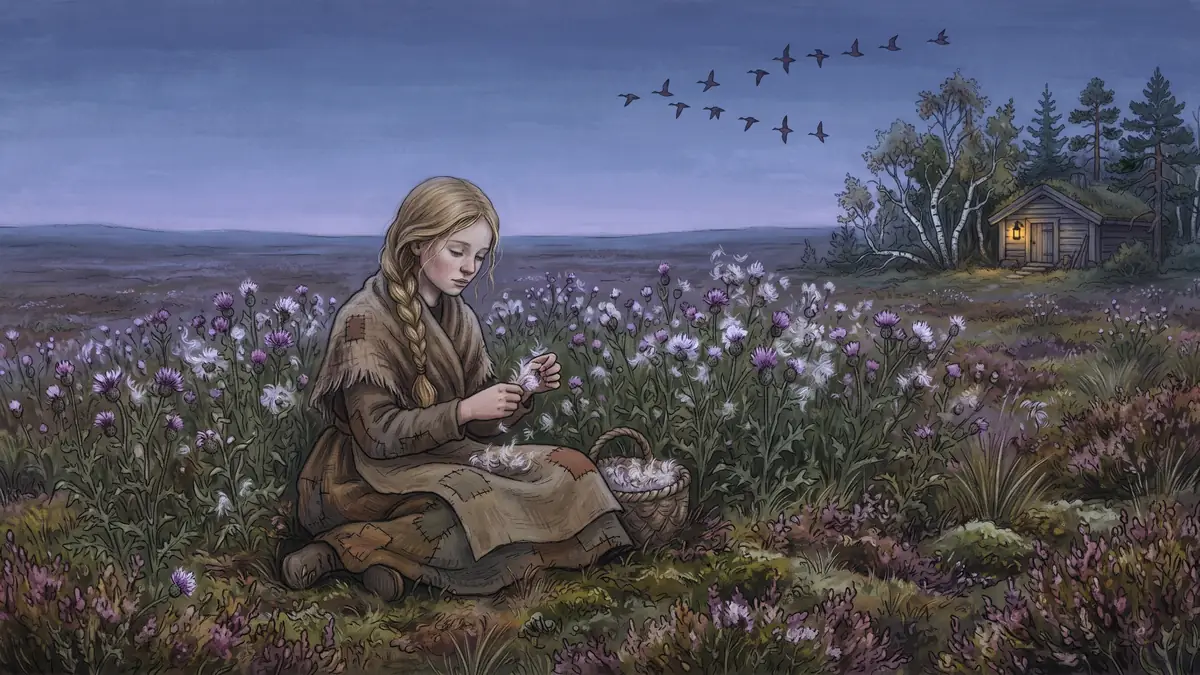
Among the tales that Peter Christen Asbjørnsen and Jørgen Moe collected in Norway, there is one in which the heroine has to overcome three prohibitions at once: she may not speak, laugh or weep. I read the tale in George Webbe Dasent’s English translation, titled “The Twelve Wild Ducks”, and the details below come from it.
The queen’s promise
A queen drives in a sleigh over fresh snow, and her nose bleeds. Seeing the red blood on the white snow, she wishes for a daughter “as white as snow and as red as blood”. An old troll who is a witch grants the wish on one condition: the queen’s twelve sons will be hers. The queen may keep them until the girl’s christening. For that day, twelve silver spoons are made for the princes and one for the daughter. At the christening, the twelve princes turn into wild ducks and fly away.
The brothers’ house
The girl grows up sad and goes out into the world to find her brothers. In a forest she falls asleep and dreams of a hut, and on waking she finds a worn path in the moss that leads to a hut like the one in her dream. Inside there are twelve beds, twelve chairs and twelve spoons. She tidies the house, cooks, eats and hides under the youngest brother’s bed, leaving her spoon on the table. The ducks return and become princes. They notice the extra spoon, and the eldest wants to kill her, but the youngest defends her.
The twelve shirts
They set a task: gather the down of thistles, card it, spin it and weave it, making twelve coats, twelve shirts and twelve neckerchiefs. If she does it all without speaking, laughing or weeping, the brothers will be free. A young king, out hunting, sees her on the moor and, getting no answer, takes her home and marries her. The king’s stepmother accuses her of being a witch because she does not speak, laugh or weep.
The ending
The queen has three children, and the old stepmother steals them one by one, throws them into a pit of snakes and smears blood from a cut finger on the young queen’s mouth to accuse her. The king forgives her twice, but the third time he sentences her to be burned. On the pile of wood, she lays the clothes on twelve boards. The youngest brother’s shirt lacks its left arm. Twelve ducks swoop down and take the clothes, and the youngest is left with a duck’s wing in place of an arm. The brothers tell the truth, the king finds the children alive in the pit, and the stepmother is punished.
In short
It is a tale of a sister who saves her brothers through silent work. The numbers twelve and three organize everything: twelve brothers, twelve spoons, three prohibitions, three children.
Terms
To card is to comb fibre before spinning. A moor is open land with low vegetation. A troll, in Norwegian tales, is a supernatural being, sometimes a giant, sometimes a witch.
What remains uncertain
I read the tale in English and not in the Norwegian original, so details of wording may differ. I also do not know, from these sources, from which region or from whom the collectors heard this version. Nor do I know whether the ending with the youngest brother’s wing is a mark of the Norwegian version or appears in other European versions.
To gather the thistle without speaking, laughing or weeping, play The thistle in silence.
Sources.
- Peter Christen Asbjørnsen and Jørgen Moe, Norwegian folk tales, translated by George Webbe Dasent, "Popular Tales from the Norse" (Project Gutenberg no. 8933): "The Twelve Wild Ducks"
- Peter Christen Asbjørnsen and Jørgen Moe, Norske Folkeeventyr (collection of tales gathered in the nineteenth century)