Thjálfi and Röskva: the broken bone and the two servants of Thor
In the Prose Edda, Thor eats his goats at a farm and revives them with the hammer, but one bone was broken. See how the farmer’s children, Thjálfi and Röskva, came to serve him.
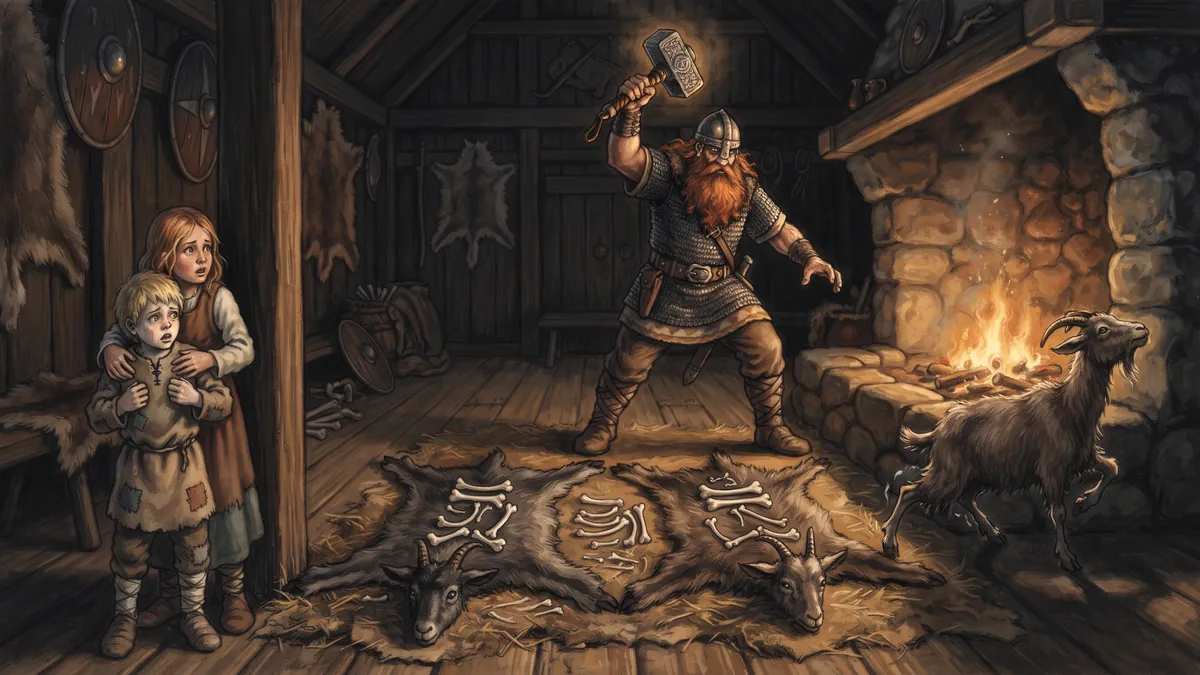
Thor has a chariot pulled by two goats, and the Prose Edda tells where the two servants who come to follow him are from. The scene is small and happens on a night of hospitality, but it explains why a boy and a girl, Thjálfi and Röskva, travel with the god.
The night at the farm
In Gylfaginning, chapter 44, Thor and Loki travel toward the home of Útgarða-Loki. In the evening, they reach a farmer’s house. Thor slaughters his two goats, which are flayed and carried to the cauldron. He invites the farmer’s family to eat and spreads the goat hides near the fire, asking that the bones be thrown onto them.
The thigh bone
Thjálfi, the farmer’s son, picks up a thigh bone from one of the goats, splits it with his knife and breaks it to get at the marrow. The next morning, Thor raises the hammer Mjöllnir and hallows the hides. The goats rise, but one of them is lame in a hind leg. Thor sees that the bone was broken.
The payment
The farmer and his family are terrified and beg for peace, offering everything they own. Thor accepts the farmer’s children, Thjálfi and Röskva, as atonement. From then on, the two become his bond-servants. Later, in chapter 45, Thjálfi races against Hugi, Thought, in the hall of Útgarða-Loki.
Thor’s reaction
The text describes the god’s anger with few images: Thor knits his brows, grips the handle of the hammer until his knuckles turn white, and the farmer and the whole household cry out and beg forgiveness. After the settlement, Thor leaves the goats at the farm and travels east with the two young people. Thjálfi is described as the fastest of men and carries Thor’s bag, which is why the race against Hugi ends up being his.
In short
In a chapter of the Prose Edda, Thor eats his goats at a farm, but the thigh bone of one of them is broken to get the marrow. When he revives the goats, he sees that one is lame and takes the farmer’s two children as servants.
Terms
Mjöllnir is Thor’s hammer. Gylfaginning is the first part of the Prose Edda. Útgarða-Loki is the giant whose hall Thor visits. Marrow is the soft core of the bone.
What remains uncertain
The translation I read does not say why Thor revives the goats by means of the hammer, nor does it explain the ban on breaking the bones. It also does not say what Thjálfi was thinking when he broke the bone, or whether the farmer knew the rule. The text only tells what each one did and the price Thor charged.
To lay the bones on the hides without touching the thigh bone, play The bones on the hide.
Sources.
- Snorri Sturluson, Prose Edda (Gylfaginning, chapters 44 to 47)
- Prose Edda, Gylfaginning, English translation consulted at voluspa.org