Thorvard Crow-Nose: the Icelander whose sail King Harald refused
In the short tale "Þorvarðs þáttr krákunefs", an Icelander offers King Harald a sail, which he refuses; the king’s son-in-law accepts it and gives gifts. See how the fastest sail ends up back with the king.
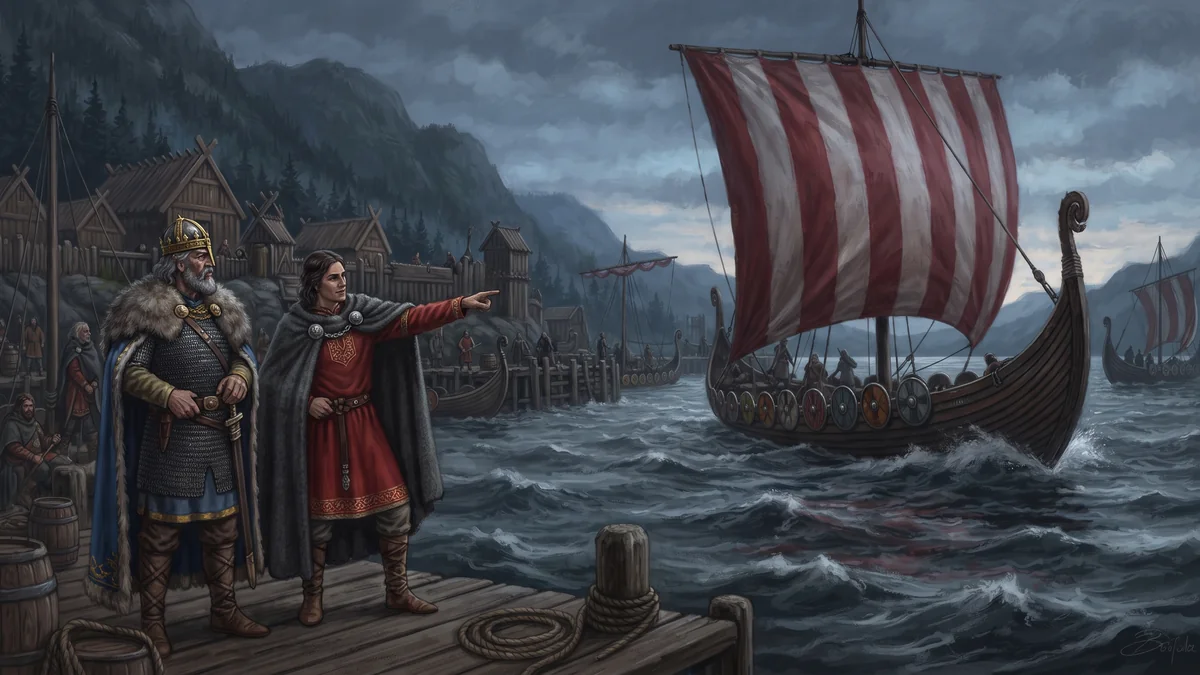
Many þættir, the short Icelandic tales, turn around a gift. In this one, the object is a ship’s sail. The Icelander Thorvard offers it to King Harald, who refuses it out of superstition, and whoever accepts it ends up with the best of sails. I read the text in Eiður Eyþórsson’s translation.
The Icelander and the sail
Thorvard, called “Crow-Nose” (krákunefr), is a wealthy Icelander of good character, from a family of the Westfjords, who travels widely. He sails to Nidaros and offers King Harald a sail from his ship. The king refuses. He recalls that he had once accepted a sail from Icelanders, which split and brought him trouble. His words in the tale are: “Once I accepted a sail from you Icelanders, and suspected it would bring me trouble.”
The king’s son-in-law
The one who accepts the sail is Eystein Orri, the king’s son-in-law and the son of Thorberg Arnason, described as the bravest of men and highly honoured by Harald. Eystein admires the sail and invites Thorvard to spend the winter on his estate, at Gizka. In spring, Thorvard goes there, receives generous hospitality and is delayed by the feasts and by the favourable winds Eystein makes wait.
The gifts
In return, Eystein gives Thorvard three gifts: a richly embroidered scarlet tunic, a grey fur cloak with a scarlet mantle and a gold ring. He says that the cloak is the true payment for the sail, and that “this will not be the payment for the sail”. Thorvard returns to Iceland and gains great standing.
The sail returns to the king
Later, the king sees Eystein’s sail racing ahead and realizes it is the one he refused. Eystein offers him the choice of sails, and the king keeps it. Even on a larger ship, the sail keeps pace with the royal ship, and the king says he has never seen a better one. He regrets having declined “something fine”.
In short
The tale shows that refusing a gift can be an expensive mistake and that whoever knows how to receive is rewarded. Thorvard’s sail passes from the king to the son-in-law and back to the king, with a ring, a tunic and a cloak along the way.
Terms
A þáttr (plural þættir) is a short Icelandic tale. Nidaros is medieval Trondheim. Flateyjarbók is a large Icelandic manuscript of the late fourteenth century.
What remains uncertain
The tale is a literary narrative, and the sources I read do not say whether Thorvard, the sail or the race existed. The translation says the king is Harald and gives no more detail. They also do not explain the nickname “Crow-Nose”.
To catch the favourable gusts of wind and let the contrary ones pass, play The gusts of wind.
Sources.
- Þorvarðs þáttr krákunefs ("The Tale of Thorvard Crow-Nose"), translation by Eiður Eyþórsson for We Vikings, based on Morkinskinna (GKS 1009 fol.) and Flateyjarbók (GKS 1005 fol.), following the edition by Guðni Jónsson, Íslenzk fornrit VI (1943)
- Morkinskinna, Icelandic manuscript of the thirteenth century