 MMXXVI
Fólkvangr, Freyja's field: where the other half of the slain warriors go
According to Grímnismál and Gylfaginning, Freyja chooses half of those who die in battle, and Odin takes the other half. See what the sources say about Fólkvangr and the hall Sessrúmnir, and what scholars debate.
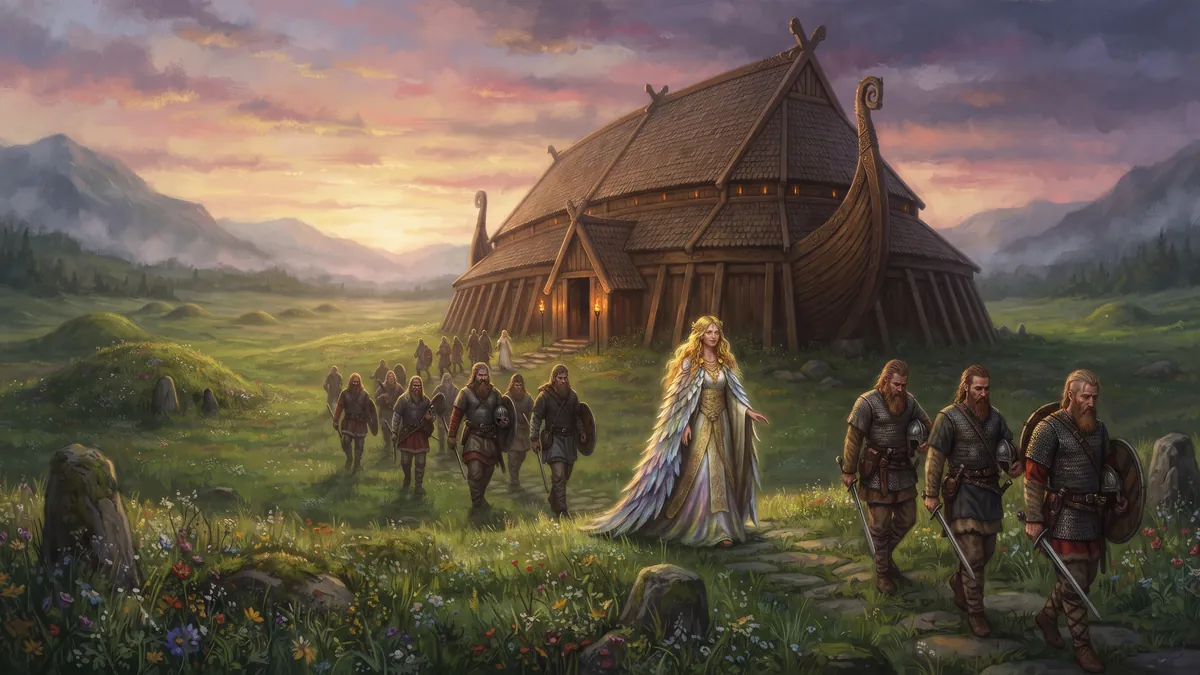
When a Norse warrior died in battle, he went to Valhalla, Odin’s hall. Or did he? The sources say that Odin takes only a part. The other half goes to a field that belongs to a goddess: Fólkvangr.
The name
In Old Norse, Fólkvangr means “field of the host”, “field of the people” or “field of the army”. The most common translation is “field of the host”.
Three texts
In Grímnismál, in the Poetic Edda, it is Odin, disguised as Grímnir, who speaks to the young Agnar. Fólkvangr is “the ninth” place he names, where Freyja decides who gets seats in her hall. She chooses half of the dead each day, and Odin takes the other half.
In Gylfaginning, in ch. 24, High tells Gangleri that Freyja is the most glorious of the ásynjur. Her dwelling is called Fólkvangr, and when she rides to battle she takes half of the slain. High then quotes the Grímnismál stanza and describes her hall, Sessrúmnir. Rudolf Simek notes that the stanza does not say this of the hall: it is an addition in Gylfaginning.
In Egils saga, after Egill refuses food, his daughter Þorgerðr vows that she does not want to live after her father and brother are dead, and she expects to meet Freyja. Wikipedia quotes her words: “I do not want to live after my father and brother are dead.”
Who goes there
Wikipedia says that half of the warriors slain in combat go to Fólkvangr. Britt-Mari Näsström adds that women who die a noble death may also go, as Þorgerðr’s vow suggests.
What scholars debate
John Lindow notes that, if the first element of the name means “army”, Fólkvangr is an alternative to Valhalla. Näsström sees two heroic paradises, perhaps tied to different initiation practices, one of Odin and one of Freyja. Hilda Ellis Davidson says Valhalla dominates the imagery so much that other halls, such as Fólkvangr and Ýdalir, have been lost to view. Simek thinks the name is “surely not much older than Grímnismál itself”.
On Sessrúmnir, Näsström explains the name as “filled with many seats” and says it serves the same function as Valhalla, where slain warriors feast. Hopkins and Haukur link the hall and the field in the image of “a ship in a field”, which they connect with Scandinavian stone ships and burial customs.
What is not in the sources
None of the passages describes the field itself: there is no mention of grass, trees or animals. What the sources offer is the idea that death in combat opens two roads, and that the one who divides the dead is a goddess and not only Odin.
In short
Fólkvangr is the field where Freyja receives the half of those slain in combat that Odin does not take, with the hall Sessrúmnir according to Snorri. Grímnismál and Gylfaginning describe it in a few lines, and Egils saga shows a woman who expects to go there. Whether it was a rival paradise to Valhalla is a matter of interpretation.
To follow Freyja’s choices in the field, play Freyja’s choices.
Sources.
- English Wikipedia, article "Fólkvangr", with the passages from Grímnismál, Gylfaginning (ch. 24) and Egils saga
- English Wikipedia, article "Sessrúmnir", cited for Freyja's hall
- John Lindow, Britt-Mari Näsström, Rudolf Simek, Hilda Ellis Davidson, Hopkins and Haukur Þorgeirsson, cited in Wikipedia