 MMXXVI
Fulla, Frigg's handmaiden: the goddess of the ash-wood box, the shoes and the secrets
Fulla is Frigg's handmaiden in Grímnismál and the Prose Edda, and she may be the same Volla of a tenth-century German charm. See what each source says about her and where scholars disagree.
Fulla appears in only a few lines, but in surprising places: in the prose introduction to a poem of the Edda, in a list of goddesses by Snorri and in a German charm of the tenth century. Her name in Old Norse can be translated as “the bountiful”. Who is she?
The maid who warns the king
According to Wikipedia, in the prose introduction to Grímnismál, Frigg sends her handmaiden Fulla to warn King Geirröd that a magician, really Odin in disguise, will visit him. Fulla also gives the king a way to recognize him: no dog will attack him.
What Snorri says
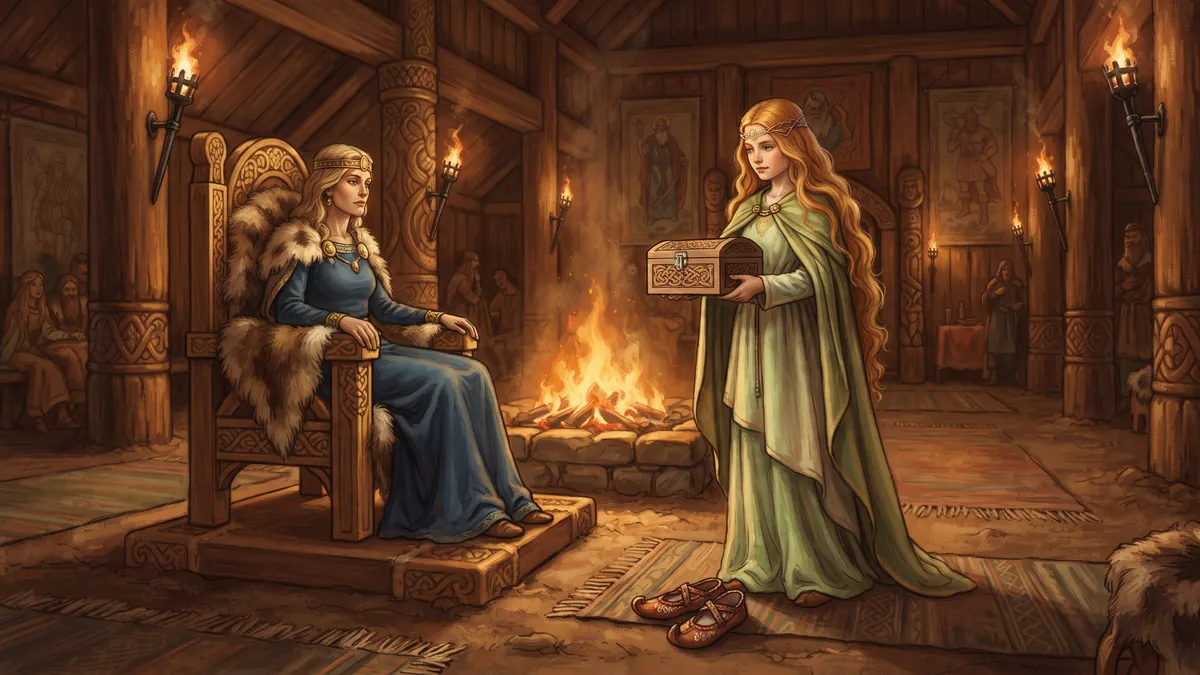
In Gylfaginning (ch. 35), High lists Fulla fifth among the 16 ásynjur, the goddesses of the pantheon. She is a virgin, wears her hair loose with a gold band around her head, and is compared to Gefjun. She keeps Frigg’s ash-wood box (eski), looks after the goddess’s shoes and is the confidante of her secrets.
In chapter 49, after the death of Baldr and Nanna, Baldr sends gifts from the realm of Hel. The only item named as a gift for a particular goddess is a finger-ring for Fulla. The others go to Odin (the ring Draupnir) and to Frigg (a linen robe).
Gold in the verses
In Skáldskaparmál, Fulla is one of the eight ásynjur at Ægir’s banquet. A poetic term calls Frigg “queen of Fulla”, and a kenning for gold is “Fulla’s snood”. A verse by Eyvindr skáldaspillir also speaks of her golden headgear. She also appears in a list of 27 names of ásynjur, and Wikipedia says, citing Simek, that she was known in skaldic poetry as early as the tenth century.
Volla, in the German charm
In the second Merseburg charm (the “horse cure”, in Old High German, tenth century), a figure called Volla (or Folla) is Frigg’s sister. She sings a healing charm for Balder’s foal, which sprained its foot while Phol and Wodan rode to a wood. Sinthgunt, Sunna and Frigg also sing charms before Wodan completes the cure.
What scholars say
The name comes from Proto-Germanic *fullōn, “fullness”, from *fullaz, “full”. John Lindow sees a possible link to fertility. For Rudolf Simek, the gift from Hel does not prove that Fulla had a role in the Baldr myth: it only shows that Snorri linked her to gold, because of the kennings. He considers her almost certainly identical with Volla and says it is unclear whether she was an independent deity, Freyja or Frigg. John Knight Bostock suggests that Fulla may have been an aspect of Frigg. Hilda Ellis Davidson calls her, together with Volla, a “vague, uncertain” figure, perhaps one of the early fertility goddesses forgotten by Snorri’s time.
In short
Fulla is Frigg’s handmaiden: she keeps the box and the shoes, knows the queen’s secrets and receives a ring from Hel. In tenth-century Germany, a Volla cures Balder’s foal. How the two are related, and how they relate to Frigg or Freyja, is a hypothesis, not a fact.
To hand Frigg what she asks for, play What Frigg asks for.
Sources.
- English Wikipedia, article "Fulla", with the passages from Grímnismál, Gylfaginning (ch. 35 and 49), Skáldskaparmál and the Merseburg charm
- Rudolf Simek, John Lindow, Andy Orchard, Hilda Ellis Davidson and John Knight Bostock, cited in Wikipedia