 MMXXVI
Hallgerðr langbrók: three marriages, a slap and the hair she would not give
Hallgerðr Höskuldsdóttir is one of the most discussed characters in the Icelandic sagas. See what Njáls saga tells of her three husbands, the feud with Njáll's wife and the request for a lock of hair, and what scholars say about how she is portrayed.
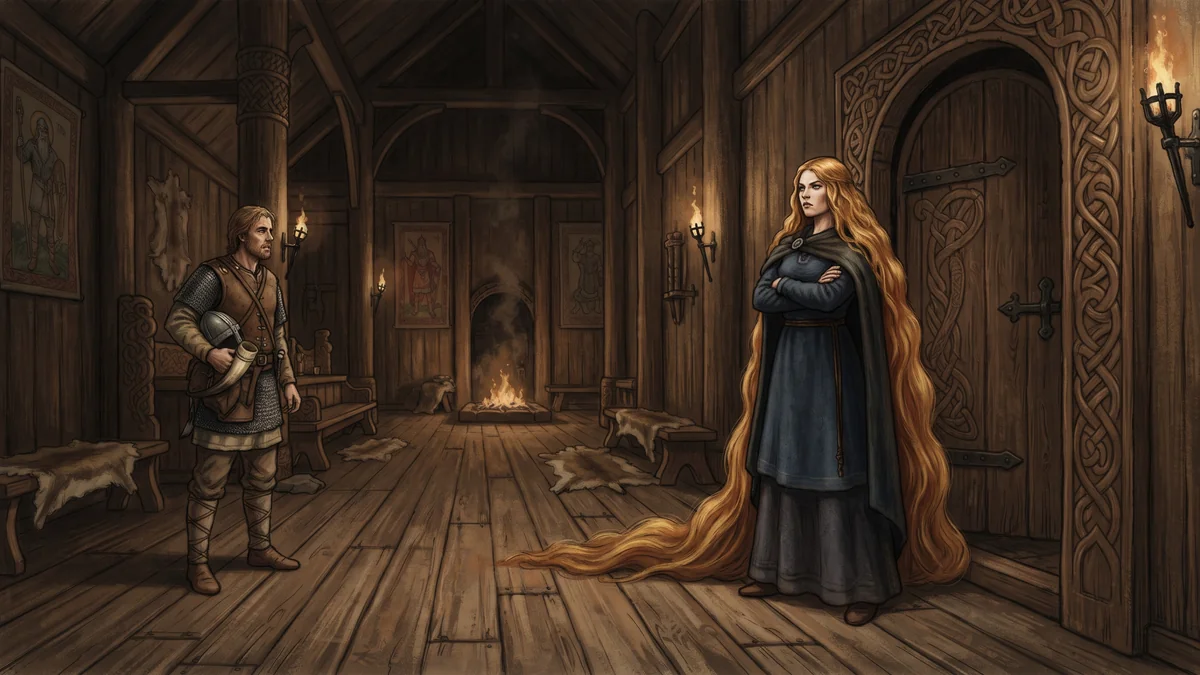
Few names in the Icelandic sagas stir as many opinions as Hallgerðr langbrók. For some she is the root of evil in Njáls saga. For others, a woman reacting to what life gave her.
Who she was
Wikipedia says Hallgerðr was the daughter of Höskuldr Dala-Kollsson, who lived at Höskuldsstaðir in Laxárdalr. Her mother hardly appears in the narrative. Landnámabók names as her brothers or half-brothers Þorleikr, Olaf the Peacock, Helgi, Þúriðr and Þorgerðr.
As an adult she had hair “so long that it could veil her whole body”. She was tall, which gave her the nickname langbrók, “long breeches”. Landnámabók gives another, snúinbrók, “twisted breeches”. She is described as impetuous and wilful. Her foster-father Þjóstólfr, violent and intransigent, is said to have influenced her for the worse.
The three husbands
- Þorvaldr Osvifsson. She did not want to marry him. Þjóstólfr killed him.
- Glúmr Ólafsson. They had a daughter, Þorgerðr. In Dasent’s translation, in ch. 16, “at last Glum gave her a blow with his hand”. Þjóstólfr killed Glúmr, against her wishes.
- Gunnar Hámundarson. They met at the Althing. They had two sons, Högni and Grani.
The feud with Bergþóra
Wikipedia says Hallgerðr was one of the main instigators of the feud between Gunnar and Njáll Þorgeirsson. She and Njáll’s wife, Bergþóra Skarphéðinsdóttir, made escalating retaliatory strikes, sending people to kill members of each other’s households.
The hair
In ch. 48, Hallgerðr has the servant Malcolm steal food from a neighbouring farm, and Gunnar slaps her when he sees the food on the table.
In ch. 76, Gunnar is besieged in his house and his bowstring has been cut. He asks Hallgerðr and his mother to twist locks of her hair into another. She refuses, recalls the slap and says she does not care whether he holds out long or short. Gunnar is killed.
Afterwards
After Gunnar’s death she settles at Grjotá with her son Grani. In the saga, her mother-in-law Rannveig blames her for her son’s death, and Hallgerðr flees with Grani.
What scholars say
- Ian Maxwell repeatedly calls her “the root of evil” and “the cause of evil”.
- Ursula Dronke reads her behaviour as “her response to progressive disappointment in marital life”.
- George Clark and Andrew Hamer argue that her nature should be understood through Hrútr’s description before her marriage, which calls it “very mixed”, with “potential for honour or disgrace”.
What the text does not settle
Wikipedia shows that readers disagree. The saga tells the actions, but whoever reads them may see them as malice, as reaction, or as both at once.
In short
Hallgerðr is remembered for the deaths of husbands, for a feud between two households and for a refusal. The request for a lock of hair, at the hardest moment of Gunnar’s life, became the scene that defines her. Readings of her change with the scholar.
To train your reasoning with the conflicts between the two households, play The hair bowstring.
Sources.
- English Wikipedia, article "Hallgerðr Höskuldsdóttir", with Landnámabók and Njáls saga
- Njáls saga, English translation by George Webbe Dasent, The Story of Burnt Njal, Project Gutenberg, ch. 16, 48 and 76
- Ian Maxwell, Ursula Dronke, George Clark and Andrew Hamer, cited in Wikipedia