 MMXXVI
Hræsvelgr: the giant in the shape of an eagle who makes the wind with his wings
In the Poetic Edda and the Prose Edda, the wind comes from the wings of an eagle-giant sitting at the end of the sky. See what the texts say, what the name means and what stays unanswered.
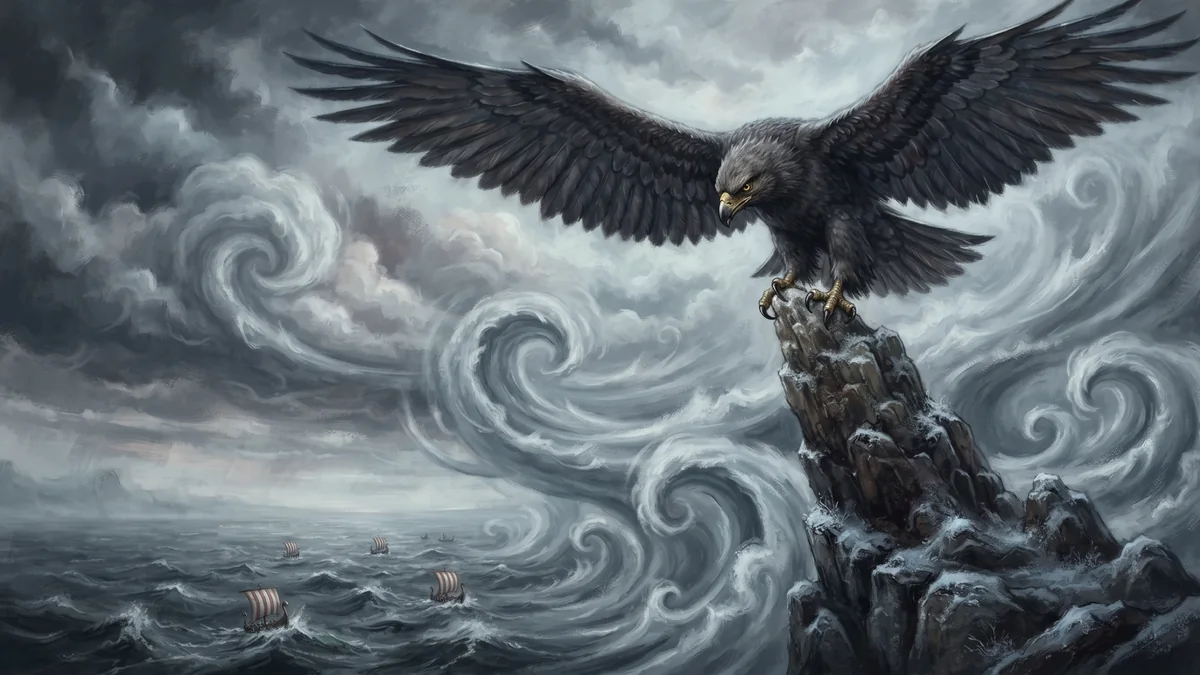
In Norse mythology, the wind has an owner. Two sources say that it comes from the wings of a giant in the shape of an eagle, named Hræsvelgr, who sits at the end of the sky. It is a short image, but it shows how the Norse imagined the sky: as a place with edges, where beings from outside the world of the gods live.
Odin’s question
In the Vafþrúðnismál, a poem of the Poetic Edda, Odin disguises himself as a traveller called Gagnráðr and visits the giant Vafþrúðnir for a contest of knowledge. Whoever gets an answer wrong loses his head. Among the questions, Odin wants to know where the wind comes from. The giant answers that it is Hræsvelgr, a giant who sits at the end of the sky in the shape of an eagle, and that from his wings, they say, the wind passes over all peoples. This is stanza 37.
What Snorri adds
In the Gylfaginning, Gangleri, the disguised King Gylfi, asks Hár where the wind comes from. The answer repeats the idea of the poem and completes it: Hræsvelgr sits at the northern end of the sky, in the shape of an eagle, and when he spreads his wings to fly, the wind is born beneath them. The page I consulted does not give the chapter.
The name
The name Hræsvelgr is usually translated as “corpse-swallower”, according to Orchard (1997) and Lindow (2002). Lindow also records another reading, something like “shipwreck-current”. The name speaks of the dead, not of wind, and the page I consulted does not explain that difference. It only cites a 1998 article by Jón Hnefill Aðalsteinsson, “Hræsvelgr, the Wind-Giant, Reinterpreted”, without summarising what he argues.
A giant, not a god
The poem calls Hræsvelgr a giant, a jötunn. It does not say that anyone honours him or that he is a god. The wind comes, then, from a being that tradition places at the edges of the world, not from one of the Æsir. The source also does not say why he sits at the far end of the sky, or where he blows.
The contest in which he appears
The passage is part of a contest of questions and answers about the world. The other questions in the poem deal, for example, with the horses that draw the day and the night, with the rivers and with the end of the world. At the end, Odin asks a question that only he can answer, about what he whispered to his son Baldr on the pyre, and that is how he wins.
In short
Hræsvelgr is a giant in the shape of an eagle who, at the end of the sky, makes the wind with his wings. He appears in two sources, the Vafþrúðnismál and the Gylfaginning, and the second follows the poem closely.
Terms
Jötunn is the Norse word for giant. Poetic Edda is the collection of poems about gods and heroes preserved in a thirteenth-century manuscript. Prose Edda is Snorri Sturluson’s work on the myths and on poetry.
What remains uncertain
No source says why the name speaks of corpses. The page consulted does not give the chapter of the Gylfaginning and does not summarise the 1998 article. It is probable, but not proved, that Snorri took the image from the poem itself.
To blow the wind in the right direction, play The wind from the wings.
Sources.
- Poetic Edda, Vafþrúðnismál (stanza 37)
- Snorri Sturluson, Prose Edda (Gylfaginning, the passage on the wind)
- English Wikipedia, article "Hræsvelgr", consulted to check the references and the name (Orchard 1997, Lindow 2002)