 MMXXVI
Ilmarinen and the golden bride: the smith of the Kalevala who forged a wife and found her cold
After losing his wife, the smith Ilmarinen forges a bride of gold and silver. See rune 37 of the Kalevala, what goes wrong and what Väinämöinen tells him.
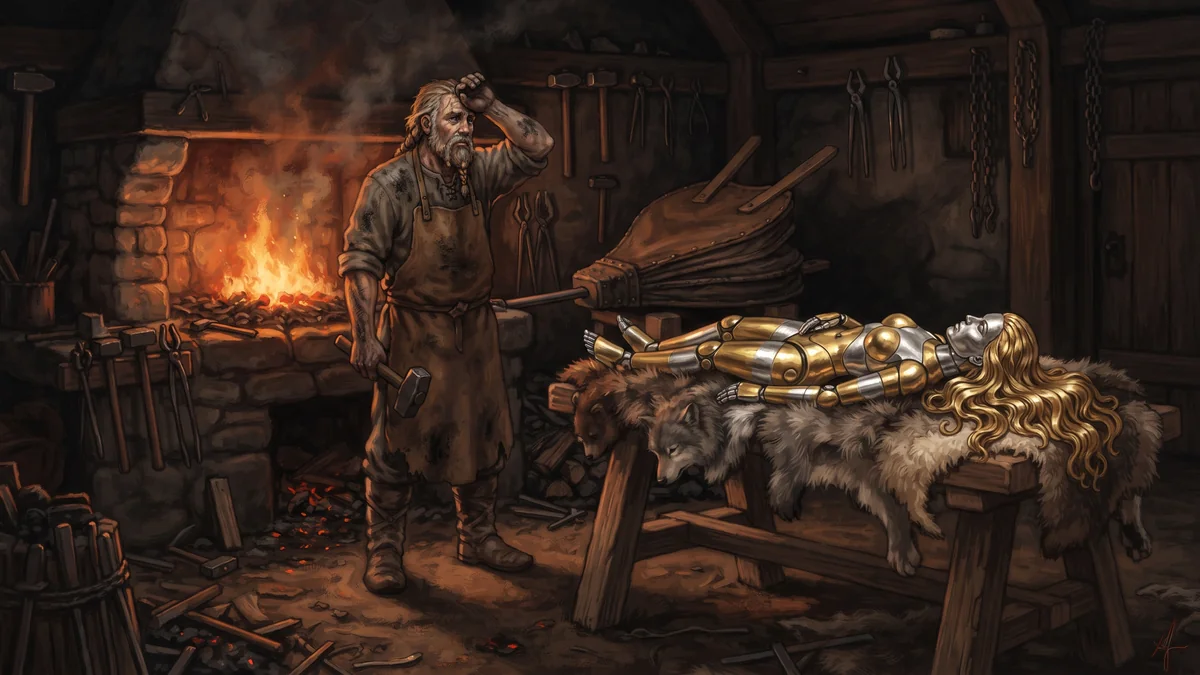
The Kalevala, the epic that Elias Lönnrot assembled from Finnish oral poems, has an episode that reads like an old science-fiction story: a smith who, after losing his wife, tries to build another. It is the episode of Ilmarinen and the golden bride, which fills rune 37. I read it in John Martin Crawford’s English translation of 1888.
The smith in mourning
Ilmarinen is the great smith of the Kalevala, the one who forged the sky and, in tradition, the Sampo. When his wife, the Maiden of the Rainbow, dies, he does no work for three months. Then he decides to make a bride of metal. He gathers gold taken from the bottom of the sea, silver and birch wood, which he burns to ash for the furnace. Servants work the bellows while he lays gold on the embers, together with a piece of silver in the shape of a lamb or hare.
Three attempts
The first piece is a little lamb with hair of gold and copper and threads of silver. Ilmarinen rejects it and returns it to the fire. The second is a colt with a golden mane, a silver head and copper hooves, which he also rejects. The third is a maiden with golden hair and a silver head, beautiful in body and face. Everyone is amazed, but she has a flaw: her feet cannot walk, her arms cannot embrace, her ears cannot hear, her mouth cannot speak and her eyes cannot see. Ilmarinen laments that she would be wise if she received the breath of Ukko, the god of the sky.
The cold night
He lays her on the silk bed, washes her with three cans of crystal water and covers himself with bearskins and wool blankets to sleep beside her. The side of his body turned toward the statue grows icy, while the other stays warm. Convinced that the bride was not made for him, Ilmarinen takes her to Väinämöinen.
The old singer’s advice
Ilmarinen asks his friend to make her fair and suitable for his old age, as a companion and comfort. Väinämöinen refuses. He tells him to throw her back into the furnace and turn her into jewellery, or to take her to Estonia and Pohjola, where powerful rivals would fight over her as a prize. He swears that he will never marry a bride of metal. The rune ends with Väinämöinen gathering the people and warning that no one should choose a wife of gold or silver, because the lips of the golden maiden are cold and silver breathes the breath of sorrow.
In short
Ilmarinen forges a bride of gold and silver to replace his dead wife, but she is cold, mute and lifeless. Väinämöinen tells him to melt the piece down, and the rune closes with a warning to the people.
Terms
Rune is each song of the Kalevala, which has 50. Ukko is the Finnish god of the sky and thunder. Pohjola is the land of the north, in the poem.
What remains uncertain
I read the episode in an English translation of 1888, and the details of the pieces and the metals may vary in other translations. The text does not say how the bride was made beyond the smith’s own actions, and the explanation of the final warning is my own reading: it is Väinämöinen’s advice, not a rule of the poem.
To lay gold on the embers without burning it or cooling it too much, play The gold on the embers.
Sources.
- Elias Lönnrot, Kalevala (1849 edition), rune 37, English translation by John Martin Crawford (1888, Standard Ebooks)