 MMXXVI
Ölkofra þáttr: the ale-seller who burned the forest of six chieftains and escaped outlawry
A hooded ale-seller sets fire to the forest of six Icelandic chieftains and is sued at the Althing. See how two men save him with a settlement of six ells of cloth.
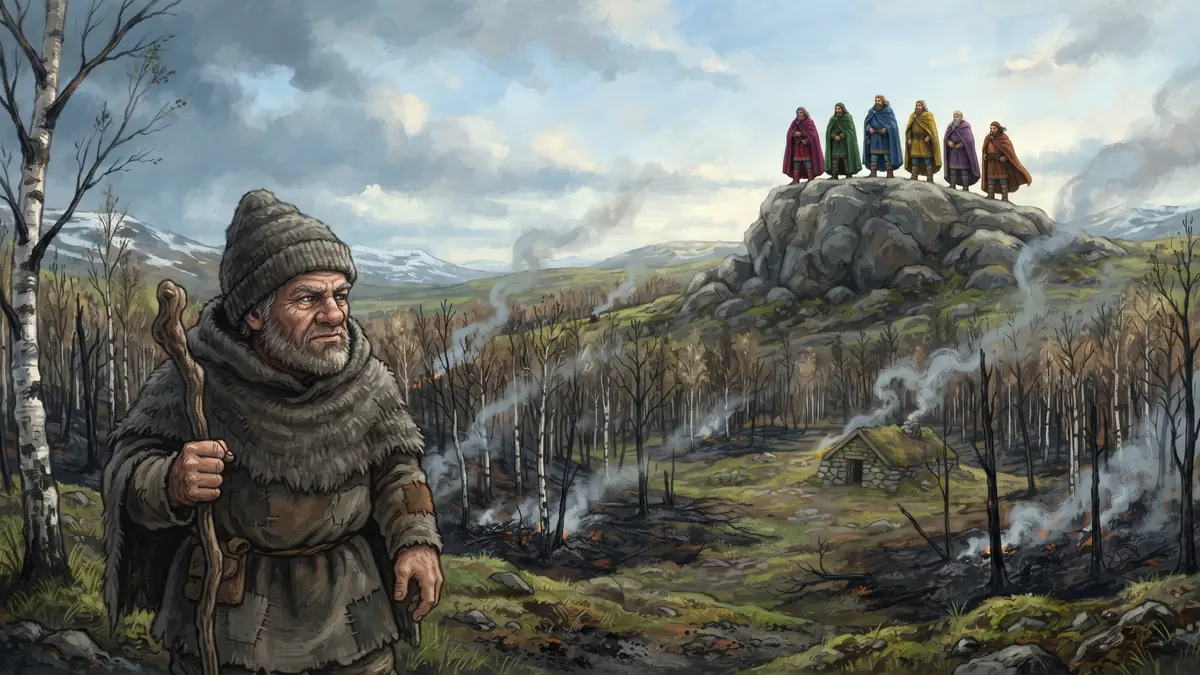
In medieval Iceland, a quarrel did not end with a blow but in a court. The Ölkofra þáttr, “the tale of Ölkofri”, tells of such a dispute, about an ale-seller who sets a forest on fire, and shows how the law could be used with cunning. Scholars see in the tale a satire on the judicial system of the Icelandic Commonwealth.
The hooded brewer
Þórhallr lives at Thorhallstadir, in Blaskogar. He brews ale for the assemblies and is known for being thrifty and for wearing a hood, which gives him the nickname Ölkofri, “Ale-Hood”. One autumn, he burns charcoal in the forest above Hrafnabjorg, falls asleep, and the fire spreads to Godaskog, the forest of six powerful chieftains. The burned area gets the name Svidning.
The six chieftains
The forest belonged to Snorri the chieftain, Gudmund Eyjolfsson, Skafti the Lawspeaker, Thorkel Geitisson, Eyjolf the son of Thord the Yeller and Thorkel the Red, son of Bjarni. Skafti, who had lost timber, spreads the news and takes charge of the case. In spring, he sues Ölkofri at an assembly, asking for outlawry. At the summer Althing, the six decide to go ahead and demand a large payment or the right to judge for themselves.
Nobody wants to help
Ölkofri asks the ale customers for support, and all refuse. Thorstein Hallsson also refuses at first. Then Broddi, Thorstein’s brother-in-law, takes pity on the brewer and brings him to him. Thorstein agrees to help, as long as Broddi helps too.
The settlement
Ölkofri humbles himself before Gudmund and Skafti. Skafti mocks him at first, but Gudmund suggests letting the brewer choose the arbitrators. The two chieftains agree to settle rather than judge, shake hands before witnesses, and Skafti withdraws the suit. Ölkofri chooses Thorstein and Broddi.
The six ells
At the Law Rock, Thorstein declares that the forests are worth nothing and orders each chieftain to be paid six ells of cloth on the spot. Broddi cuts the cloth and throws out the pieces, calling it a petty tax. Insults rise, and Snorri, Thorkel Geitisson, Eyjolf and Skafti trade barbs with Broddi. In the end, Broddi apologises to Thorkel Geitisson, gives him an ornamented sword and invites him to a feast. The two become lasting friends.
In short
Ölkofri sets the forest of six chieftains on fire by carelessness, escapes outlawry thanks to two men who arbitrate a ridiculous payment, and leaves the chieftains humiliated. The satire shows how the law could be bent by someone who knew how to use the right words.
Terms
Althing is the national assembly of Iceland. Ell is the measure of cloth. Outlawry is the penalty that removed the protection of the law.
What remains uncertain
The tale survives in the manuscript Möðruvallabók, from the fourteenth century, which calls it Ǫlkofra saga, and today it is preferred to call it a þáttr, a short tale. The page consulted gives no date of composition. The link between Ölkofri’s trade and barley grown in Iceland is a suggestion by scholars.
To put out the sparks before they reach the forest, play The sparks in the forest.
Sources.
- Ölkofra þáttr (Möðruvallabók, 14th century), in an English translation consulted on the page "The Saga of Ale-Hood" (wevikings.com)
- English Wikipedia, article "Ölkofra þáttr", consulted to check manuscripts, traditions and studies