 MMXXVI
Pesta: the old woman of the Black Death in Norwegian folklore, with rake and broom
In Norwegian legends the Black Death travels from farm to farm as an old woman with a rake and a broom. See what each tool means and what Kittelsen's drawings show.
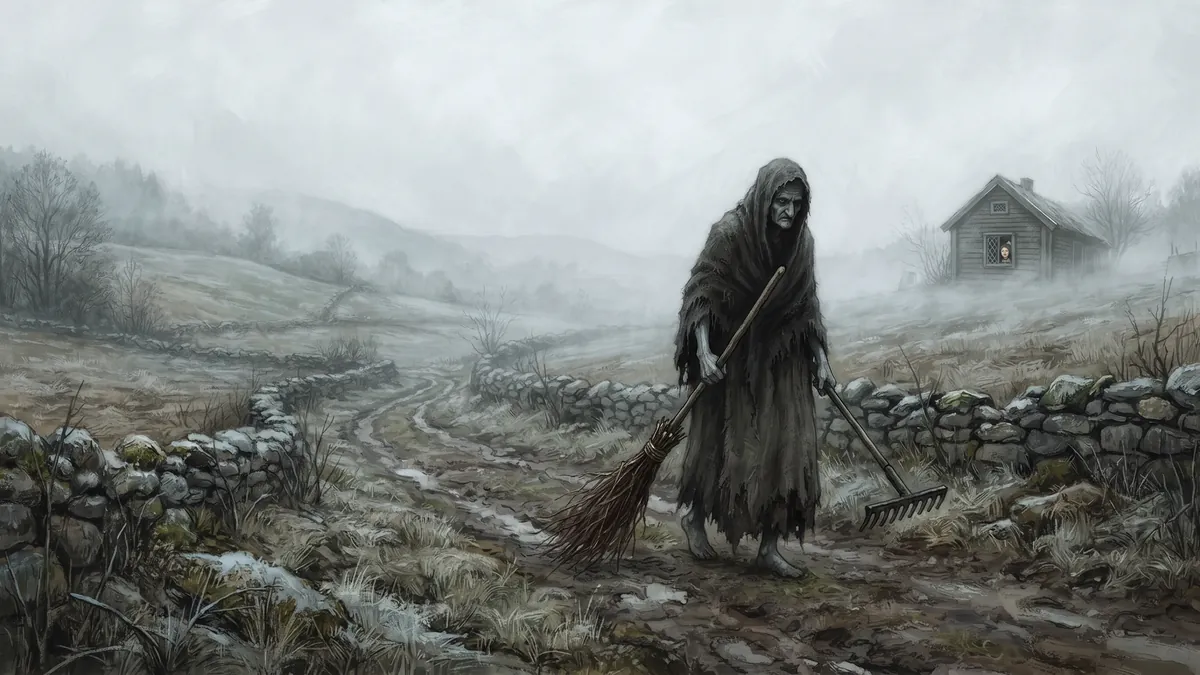
In Norway, the Black Death epidemic was called “the great dying” (den store mannedauden). In the legends that remember it, the disease gets a face: that of an old woman who goes from farm to farm, and she has a name, Pesta. This text gathers what I read about her, in two pages and a folklorist’s article.
A grey old woman with broom and rake
In tradition, Pesta is a pale, grey old woman, gammel, gråblek kjerring. She travels from farm to farm with a broom (sopelime) and a rake (rive). Where she uses the broom, everyone dies. Where she uses the rake, some escape.
The legends of those who were left
One of the best-known legends is that of Jostedalen: there everyone died except a small girl, who became known as Jostedalsrypa. In a parish of Hardanger, only a boy and a girl were left. In Valle, in Setesdal, only one girl escaped, at the farm of Uppstad. Similar legends were collected in nearly thirty districts of Norway, as far as Helgeland in the north.
The same theme in other countries
The folklorist Timothy R. Tangherlini noted that, in Norway and Sweden, legends often show the plague as a woman who walks alone or as a pair of children with a rake and a broom. That article also notes that the forms of the legends may be linked to the areas the disease came from.
Kittelsen’s drawings
The painter and draughtsman Theodor Kittelsen made, in the 1890s, a series of drawings based on the legends, among them Pesta kommer. In 1900 he published the book Svartedauen, with texts of his own, twelve full-page illustrations and small vignettes. It was through this work that the image of Pesta became known to many Norwegians.
The debate over how many died
The legends paint an almost empty country, and historians argued about it for decades. Ernst Sars, Edvard Bull the Elder and Johan Schreiner maintained until the 1970s that the mortality cannot have been so high. More recent historians, such as Kåre Lunden and Jørn Sandnes, used signs such as abandoned farms and largely support the estimates of the Icelandic annals, according to which the population of Norway fell to a third around 1400.
In short
Pesta is the Black Death personified, an old woman with a broom and a rake. The legends of survivors appear in nearly thirty districts, and the image was fixed by Kittelsen’s drawings.
Terms
Sopelime is the broom, and rive is the rake. Jostedalsrypa is “the ptarmigan of Jostedalen”, the name given to the girl who survived in the legend.
What remains uncertain
The pages I read do not explain the origin of the name Pesta or say when each legend was recorded. The number of dead is a matter of debate among historians.
To help the girl escape the broom, play The girl and the broom.
Sources.
- "Pesta kommer", Tidsskrift for Den norske legeforening (tidsskriftet.no, 2007), on the Norwegian legends of the Black Death and Theodor Kittelsen's drawings
- Theodor Kittelsen, "Svartedauen" (1900), drawings and texts on the Black Death
- Timothy R. Tangherlini, "Ships, Fogs, and Traveling Pairs: Plague Legend Migration in Scandinavia", Journal of American Folklore, vol. 101 (1988)