 MMXXVI
The Frösö stone: the northernmost runestone in Scandinavia and the man who "brought Christianity to Jämtland"
On the island of Frösön in northern Sweden, an eleventh-century stone records that Austmaðr, son of Guðfastr, raised it, had a bridge built and Christianized Jämtland. See what the inscription says and who made it.
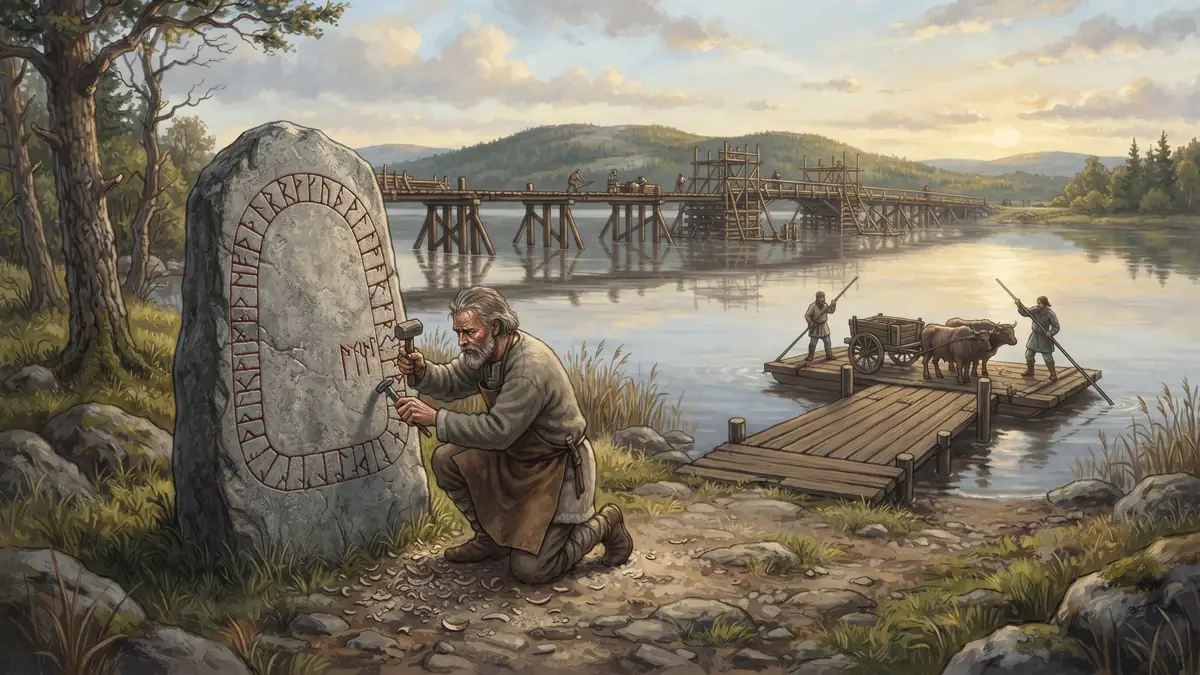
Some runestones remember the dead. The one at Frösö remembers a bridge and a conversion. It is the northernmost raised runestone in Scandinavia, and the only one in Jämtland.
The stone
The stone stands in Östersund, in Jämtland, Sweden. It originally stood at the tip of a ferry terminal, on the sound between the island of Frösön and Östersund. It was moved to the lawn in front of the county seat during the construction of a new bridge, between 1969 and 1971. It is dated between 1030 and 1050.
What the inscription says
Paraphrased: Austmaðr, son of Guðfastr, had this stone raised and a bridge built, and brought Christianity to Jamtaland. Ásbjörn built the bridge, and Trjónn and Steinn carved the runes.
The man and the names
Austmaðr means “man from the east”. Wikipedia describes him as an Old West Norse speaker from mainland Scandinavia, and gives his father’s name, Guðfastr. Beyond that, the page says nothing about his life.
The names have meanings. Guðfastr is “faithful to God”. Ásbjörn is “god bear”. And Trjónn, which Wikipedia glosses as “snout”, is a name specific to Jämtland. The other two names, Trjónn and Steinn, are those of the rune masters.
The bridge and the ferry
The inscription says Ásbjörn built the bridge, and the stone stood at the crossing point. The page gives no further details about how the bridge was made. But the fact that the stone stood there, at the crossing, suggests what it marked: a place of passage between the banks, and between two religions.
Why it matters
Wikipedia says the stone commemorates Austmaðr’s Christianization of Jämtland rather than being a cenotaph, a memorial to someone buried elsewhere. The page describes this as unique, though it cites no source for that claim. It also says that, in the whole world, the northernmost runestone is the Kingittorsuaq stone in Greenland. The Frösö stone is the northernmost in Scandinavia.
What the stone does not say
The inscription does not say exactly where Austmaðr came from, who sent him, how the conversion went or how many people were baptized. Nor does it tell how long the bridge took to finish. It is a stone that declares a deed, in a few words, and leaves the rest to historians. That is why one must be careful with versions that turn it into a detailed account of the Christianization of the region.
In short
The Frösö stone, in Östersund, dates from the eleventh century and says that Austmaðr Guðfastsson had it raised, had a bridge built and brought Christianity to Jämtland. Ásbjörn built the bridge, and Trjónn and Steinn carved the runes. The stone is the only one in Jämtland and the northernmost in Scandinavia.
To set each plank of the bridge in place, play The planks of the bridge.
Sources.
- English Wikipedia, article "Frösö Runestone" (J RS1928;66)