 MMXXVI
The Piraeus Lion: the runes Vikings carved on a Greek marble lion, now in Venice
On a Greek marble lion in front of the Venice Arsenal, eleventh-century Scandinavians left runes. See what the inscriptions say, who studied them and what is still unknown.
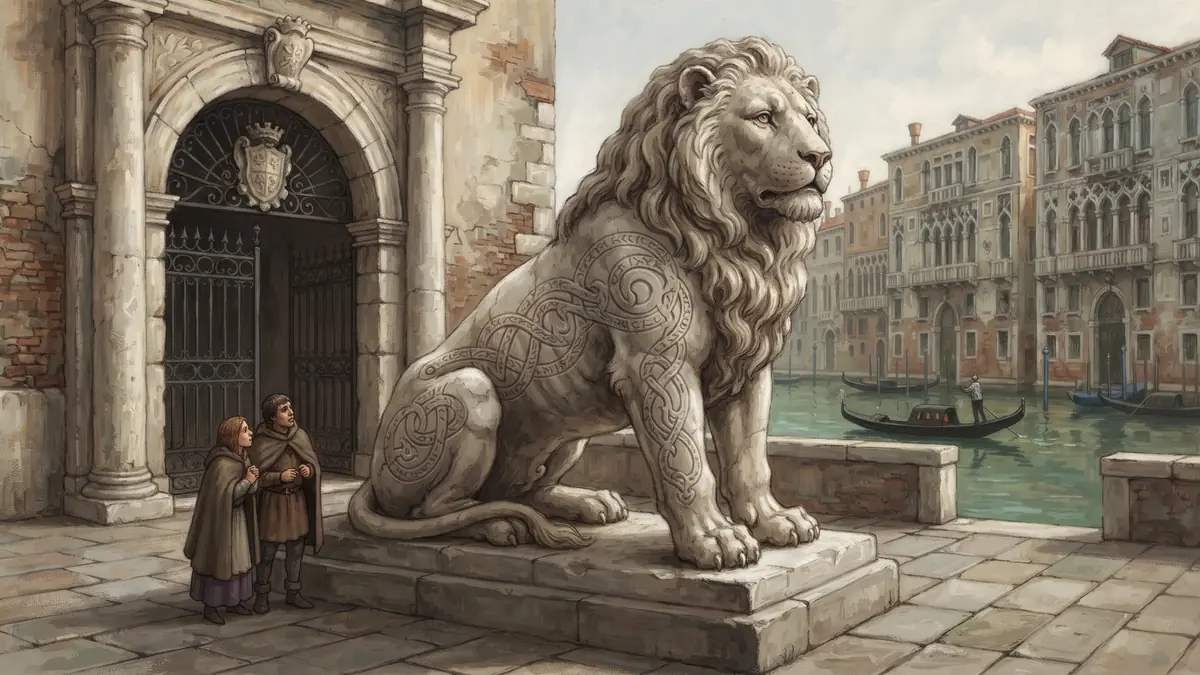
In front of the Venice Arsenal, the city’s old naval base, stands a marble lion that was carved in ancient Greece. On its flanks, eleventh-century Scandinavians carved runes. It is one of the few places in southern Europe where one can see a runic inscription, and the story of how it got there shows the reach of Norse travel.
From Athens to Venice
The lion is almost 2,400 years old and stood at Piraeus, the port of Athens. According to the Science Norway page, the Venetians took it in 1688, after capturing Athens from the Ottomans. Today it guards the entrance to the Arsenal.
Who saw the runes first
The Swedish diplomat and linguist Johan David Åkerblad noticed the runes on a visit to Venice around the turn of the eighteenth into the nineteenth century. Carl Christian Rafn translated the inscription on the left side in the mid-nineteenth century, but the translation is uncertain. Erik Brate made a reading in 1920. The Swedish-Icelandic researcher Thorgunn Snædal spent fifteen days studying the lion, and her 2014 study was published by Riksantikvarieämbetet, the Swedish heritage board.
The three inscriptions
The page describes three inscriptions by three different groups of Scandinavians. The oldest is on the left side and is Swedish, from the 1020s according to Snædal. It commemorates a farmer named Haursi, who died before receiving his share of the booty, and Snædal reads it as “Swedes did this on the lion”. The middle one, behind the left side, is the shortest: drængiaR ríst rúnar, “young warriors carved the runes”, and whoever made it may not have been Swedish.
The most recent is on the right side, perhaps Norwegian. It is about a hundred runes in a loop of the Urnes style, signed by a carver named Åsmund. Snædal dates it between 1070 and 1100, or perhaps a few decades later. Among the legible names are Åsmund, Asgeir (Eskil) and Torleif. About 80% of the Swedish runes and 50% of the supposedly Norwegian ones can be read.
Harald Hardrada and the lion
Some have tried to read the name of Harald Hardrada in the runes, but the page considers the reading doubtful. Snædal does not rule out that the Swedish carvers served in his army.
The state of the lion
Bullet marks, from target practice about 350 years ago, probably by Turkish or Venetian soldiers, have damaged some runes. Air pollution also wears the stone away.
In short
The marble lion of Piraeus, in Venice, has three runic inscriptions made by three groups of eleventh-century Scandinavians. They show that Norsemen reached Athens and left their mark there.
Terms
Runes are the letters of the ancient Germanic peoples. Arsenal is Venice’s naval complex. Urnes style is a style of carving with loops and animals, common in eleventh-century Norway.
What remains uncertain
The readings of the inscriptions are uncertain, and parts of them are worn away. The page consulted says that the reading of Harald Hardrada’s name is doubtful and gives no certainty about who the carvers were.
To find the pairs of runes carved on the lion, play The runes of the lion.
Sources.
- "Vikings tagged the great lion in Venice with runes", Science Norway (sciencenorway.no), on the study by Thorgunn Snædal
- Thorgunn Snædal, study of the runes of the Piraeus Lion (2014), published by Riksantikvarieämbetet
- English Wikipedia, article "Piraeus Lion", consulted to check the references