 MMXXVI
The princess who could not be silenced: the Asbjørnsen and Moe tale in which the youngest wins with six finds
A princess always has the last word, and the king promises half the kingdom to whoever silences her. See how the youngest uses what he found on the road, and why the tale still makes people laugh.
Few Norwegian tales have an ending as short and as funny as the one about the princess nobody could silence. The fun lies in a duel of words, and the winner is the poorest of three brothers, the one who walks the road picking up what others would call rubbish. I read the tale in Gudrun Thorne-Thomsen’s English version of 1912, which adapts the text of Peter Christen Asbjørnsen and Jørgen Moe.
The king’s rule
The king’s daughter is so contrary in her speech that no one can silence her. The king announces that whoever silences her will marry her and receive half the kingdom. Whoever tries and fails will have both ears branded with the red-hot iron he uses on his sheep.
The brothers and the finds
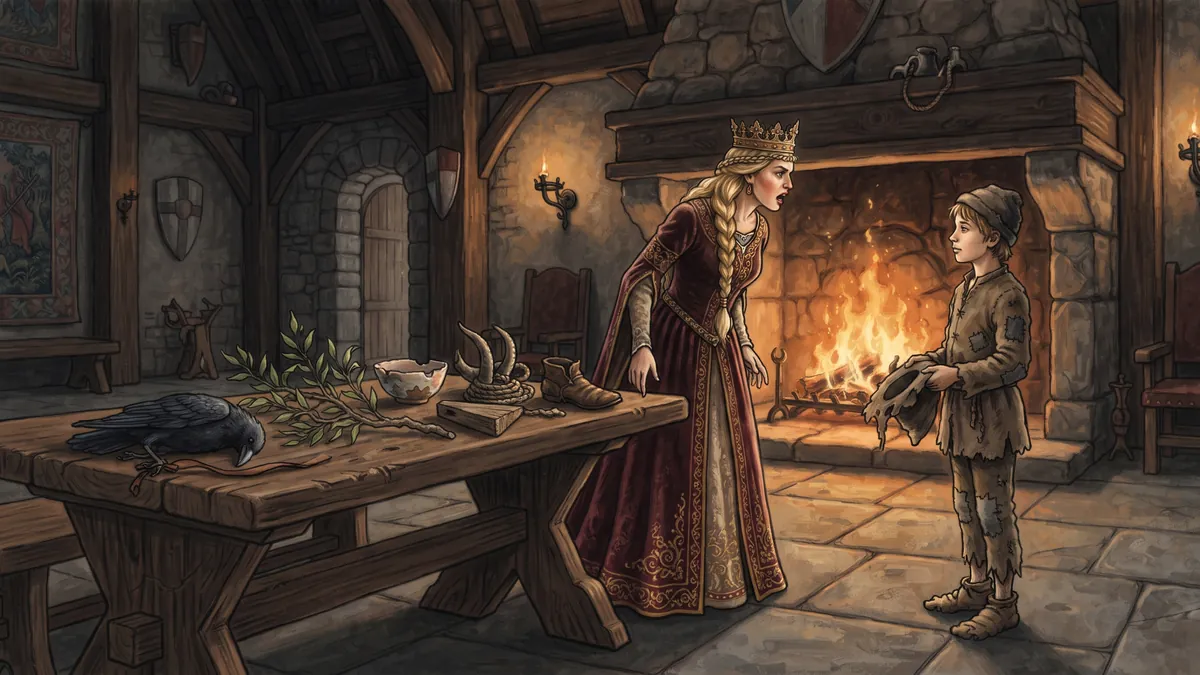
Three brothers, who are doing badly at home, decide to try their luck. The youngest is Boots in the English version, the usual hero of Norwegian tales, known in Norwegian as Askeladden. On the way he picks up six things: a dead crow, a willow twig, a piece of a saucer, two goat horns, a wedge and a worn-out shoe sole. The older brothers mock him at every find, and he only answers that he has little to carry.
The two who fail
The two older ones go in first. Each greets the princess and remarks that it is warm. She answers that it is warmer still in the fireplace, where the iron waits. Both are left without an answer and go home with branded ears.
The youngest and his things
The youngest says the place is pleasant and warm. The princess says the same of the fireplace. Then he asks whether he may roast the crow there. She fears the creature will burst, and he ties it with the willow twig. She says it has come loose, and he drives in the wedge. She warns that the fat will drip, and he holds the piece of saucer underneath. She calls him crooked in his words, and he answers that the goat horn is crooked, and shows one, and then the other, the same. She says he will wear out her soul, and he says no, because he only has a worn sole, and shows the sole. The princess has no answer left. The youngest says that she is now his, and she is.
A tale about the last word
What the tale celebrates is a simple idea: the person who always has the last word loses when someone has a ready answer for each of her sentences. The joke of the ending depends on a pun in the English version, between soul and sole, and in other languages that pun may change.
In short
The youngest picks up six things on the road and uses each to answer a sentence of the princess. She is left without words, and he wins her hand and half the kingdom. The older brothers, who failed, go home with branded ears.
Terms
Askeladden is the most common hero of Norwegian tales, the poor youngest son who wins by cunning. Red-hot iron is what the king uses to mark those who fail.
What remains uncertain
I read an English adaptation of 1912, not the Norwegian text of Asbjørnsen and Moe, so details such as the order of the answers and the pun at the end may vary in other versions. The tale does not name the princess or the king.
To give the princess the answer that each sentence calls for, play An answer for every sentence.
Sources.
- Peter Christen Asbjørnsen and Jørgen Moe, "Prinsessen som ingen kunne målbinde" (Norske Folkeeventyr)
- Gudrun Thorne-Thomsen, "The Princess Who Could Not Be Silenced", in "East o' the Sun and West o' the Moon" (Chicago: Row, Peterson and Company, 1912), version consulted on the Sur La Lune Fairy Tales page