 MMXXVI
The sheep and the pig who set up house in the forest: an Asbjørnsen and Moe tale and the wolves
A sheep and a pig escape the slaughter and build a house in the forest with the help of a goose, a hare and a cock. See how the group drives off two wolves and what the tale says about life at home.
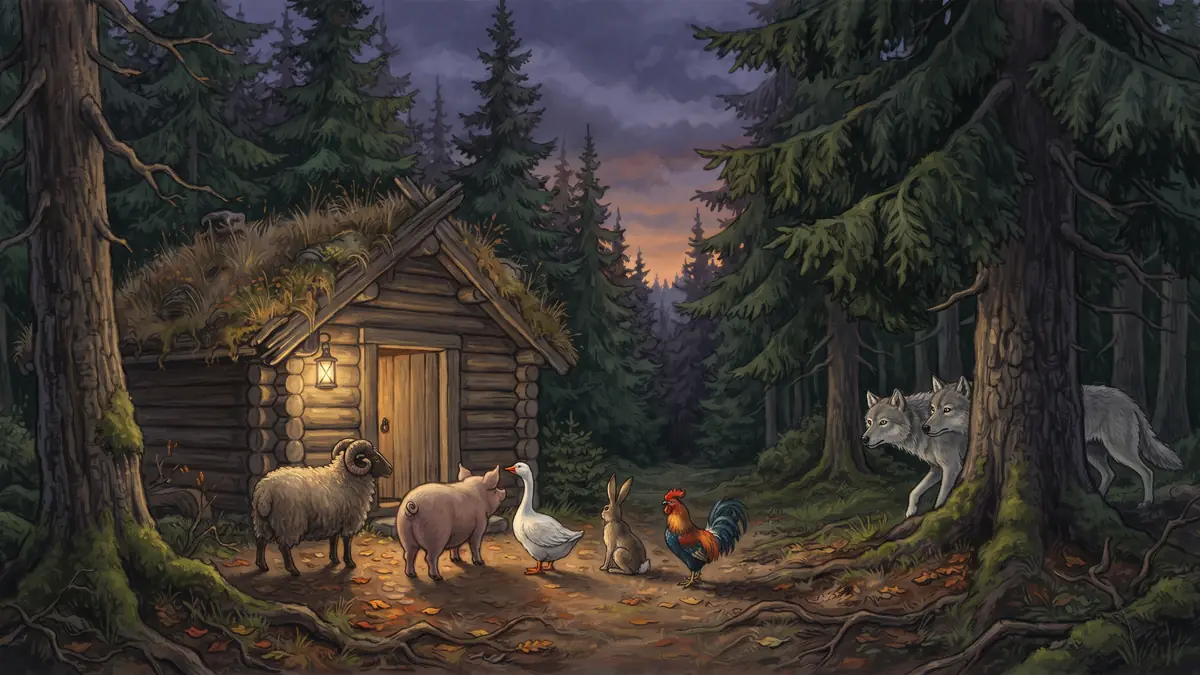
Some tales seem too simple to teach anything, and “The Sheep and the Pig who Set Up House” is one of them. Peter Christen Asbjørnsen and Jørgen Moe included it among the Norwegian tales, and George Webbe Dasent translated it into English in Tales from the Fjeld. I read the tale in that translation. It is the story of farm animals who decide not to wait for the knife.
The sheep’s escape
A sheep is being fattened in a pen. The dairymaid tells him he will be killed the next day. He eats until he is nearly bursting, escapes and goes to look for a friend, a pig on a neighbouring farm. He tells the pig that both of them will be killed and eaten, and the two decide to build a house in the forest.
The group and its tasks
On the way, the sheep and the pig recruit three other animals, each with a skill. The goose plucks moss to stuff the gaps between the planks. The hare is the carpenter and gnaws the pegs to fix the walls. The cock wakes everyone so that nobody oversleeps. The pig hews the timber and the sheep drags it home. They roof the house with birch bark and cover it with turf. The sheep sums up their life in a verse: it is good to travel east and west, but after all, a home is best.
The two wolves
Nearby is the den of two wolves, the “graylegs”. Wanting to meet the new neighbours, one of them invents an errand and goes to ask for a light for his pipe. As soon as he enters, the sheep butts him head first into the stove. The pig gores and bites him, the goose nips and pecks, the cock crows and chatters from the roost, and the hare runs about in fright, scratching in every corner. After a long time, the wolf comes out.
What the wolf tells
The other wolf, who was waiting outside, remarks that neighbourhood makes brotherhood. The wounded one answers that he was treated as an unbidden guest. He says that a shoemaker struck him with a last, that two smiths beat him with red-hot tongs, that a hunter was looking for his gun and that someone under the roof slapped his arms and cried that they should put a hook in him and drag him there. If that creature had caught him, he says, he would never have come out alive.
An ending that does not tell everything
The text I read ends with the wolf’s account and does not say what happens to the wolves afterwards. It carries no moral, and the fun lies in seeing that each animal does what it knows, and the wolf tells what he saw as if they were men.
In short
A sheep and a pig escape the slaughter, gather a goose, a hare and a cock, and build a house in the forest. When a wolf comes in, each attacks him in its own way, and he leaves telling that he was attacked by shoemakers, smiths and hunters.
Terms
Graylegs is the name the tale gives to the wolves. Turf is the sod with roots that covers roofs in Norway.
What remains uncertain
The passage I read does not say who told the tale or where it was collected. It also does not say what happens to the wolves at the end. The comparison with other animal tales in which animals join to escape slaughter, such as the Bremen musicians of the Brothers Grimm, is mine, not a statement of the text.
To drive the wolf away from the door, play The wolf at the door.
Sources.
- Peter Christen Asbjørnsen and Jørgen Moe, Norwegian folk tales, translated by George Webbe Dasent, "Tales from the Fjeld" (Project Gutenberg no. 36385): "The Sheep and the Pig who Set Up House"