 MMXXVI
Antero Vipunen, the sleeping giant of the Kalevala: the hero who went into his mouth for three words
In runos 16 and 17 of the Kalevala, Väinämöinen cannot finish his boat because three magic words are missing. He seeks them in the land of the dead and in the body of the giant Antero Vipunen. See the episode.
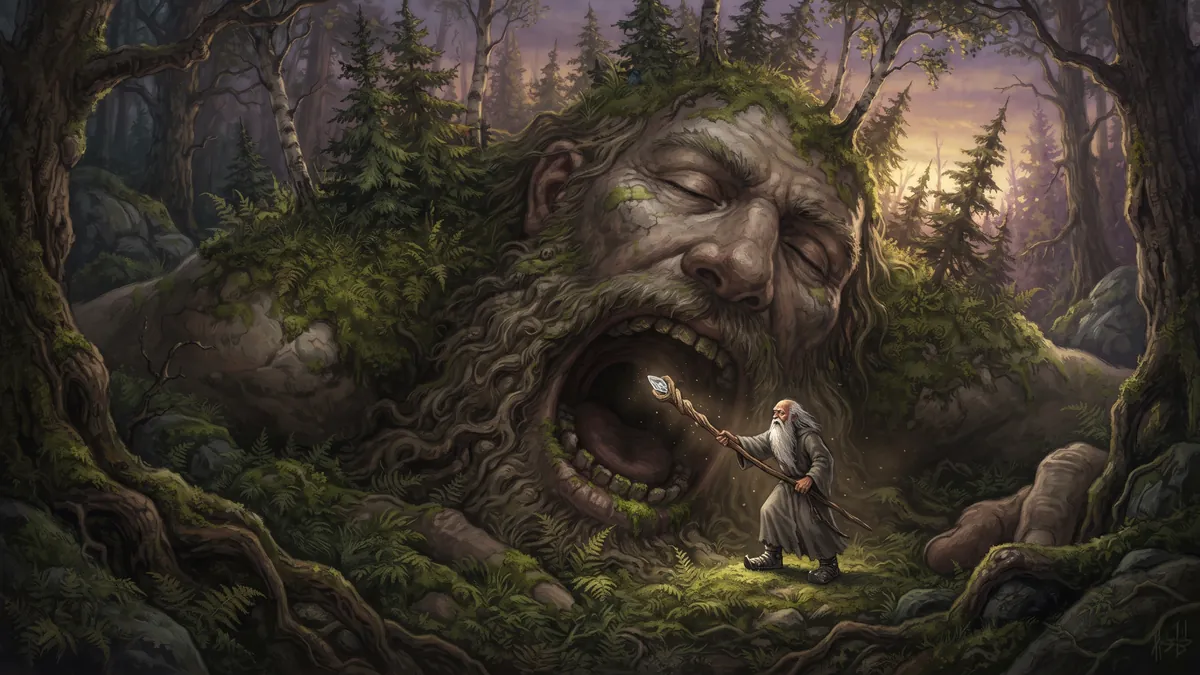
Väinämöinen is the old singer of the Kalevala, and his weapon is the sung word. That is why the episode of Antero Vipunen is so strange: the greatest singer of the poem lacks the words he needs. Crawford’s translation spells the names Wainamoinen and Wipunen, but here I use the Finnish spelling.
The boat that will not finish
In runo 16, Väinämöinen builds a boat but runs short of timber. Sampsa Pellervoinen goes to look for trees. The aspen and the pine refuse him as unsound, and an oak agrees to be cut. Väinämöinen shapes the hull, the ribs, the oars and the rudder, singing each part. But he cannot finish the ledges, the stern and the forecastle, because three words of master magic are missing.
Looking for the words
He searches in swans, ducks, swallows, reindeer and squirrels, without success. Then he travels to Tuonela, the realm of the dead. Tuoni’s daughter only ferries him across after he gives false answers (iron, water, fire) and finally the true one. Tuonetar offers him poisoned beer, which he refuses, and puts him to sleep with a wand, while Manala’s son sets nets. Väinämöinen slips away in the shape of a serpent, thanks Ukko and warns the people of Kalevala to avoid wrongdoing, because Tuonela punishes it.
The giant
In runo 17, a shepherd says the words are in the mouth of Vipunen, a wise singer. The way crosses needle points, sword edges and hatchet edges. Väinämöinen asks the smith Ilmarinen for iron shoes, copper gloves and a strong staff. Ilmarinen warns him that Vipunen has been dead for ages.
Väinämöinen finds him lying still, with trees growing from his body: an aspen on the shoulder, birches on the temples, alder on the chin, willows from the beard, fir from the mouth and oak from the forehead. He cuts the trees down with his sword and hatchet, thrusts the iron staff into the giant’s mouth and pries the jaws apart.
Inside the giant
Vipunen wakes, bites the staff without being able to cut the steel, and swallows Väinämöinen with his shoes and armour. Inside, the hero builds a little boat from the handle of his dagger and rows through the giant’s body. He sets up a forge: the armour is the workshop, the sleeves are the bellows, the knees are the anvil and the forearm is the hammer. He forges for three days.
Vipunen orders the intruder out and calls on various powers to drive him away. Väinämöinen refuses to leave before he learns the giant’s songs and wisdom. Vipunen gives in and sings the oldest lore: the origin of air, water, earth, plants, animals, the sun, the moon and the stars, and the origin of witchcraft, of good and of evil. The song lasts for days, and nature falls silent to listen, even the waterfall of Rutya.
The end
Väinämöinen learns the lost words and leaves through the giant’s mouth, and Vipunen, who admits he has been out-sung, sends him off in peace. He goes back to Ilmarinen and says he knows what is needed. Then he builds the boat by magic alone, touching it with neither hands nor feet, and launches it the same way. It is the gift for the Maid of Beauty of Pohjola. In the next runo, he sails north.
In short
Väinämöinen enters the body of the giant Vipunen to take from him the three words his boat lacks, and he gets them only by out-singing the giant himself. The episode shows the power of the word in the Kalevala, and the details come from Crawford’s translation.
To strike the forge inside the giant, play The forge inside the giant.
Sources.
- Elias Lönnrot, Kalevala, runos 16 and 17 ("Wainamoinen's Boat-building" and "Wainamoinen finds the Lost Word"), in the English translation by John Martin Crawford (1888), Project Gutenberg no. 5184