 MMXXVI
Ginnungagap, the primordial void: where ice met fire and Ymir was born
Ginnungagap is the yawning abyss that existed before the world, according to Völuspá and Gylfaginning. See what Snorri tells of the northern ice, the southern sparks and the first giant, and what scholars debate about the name.
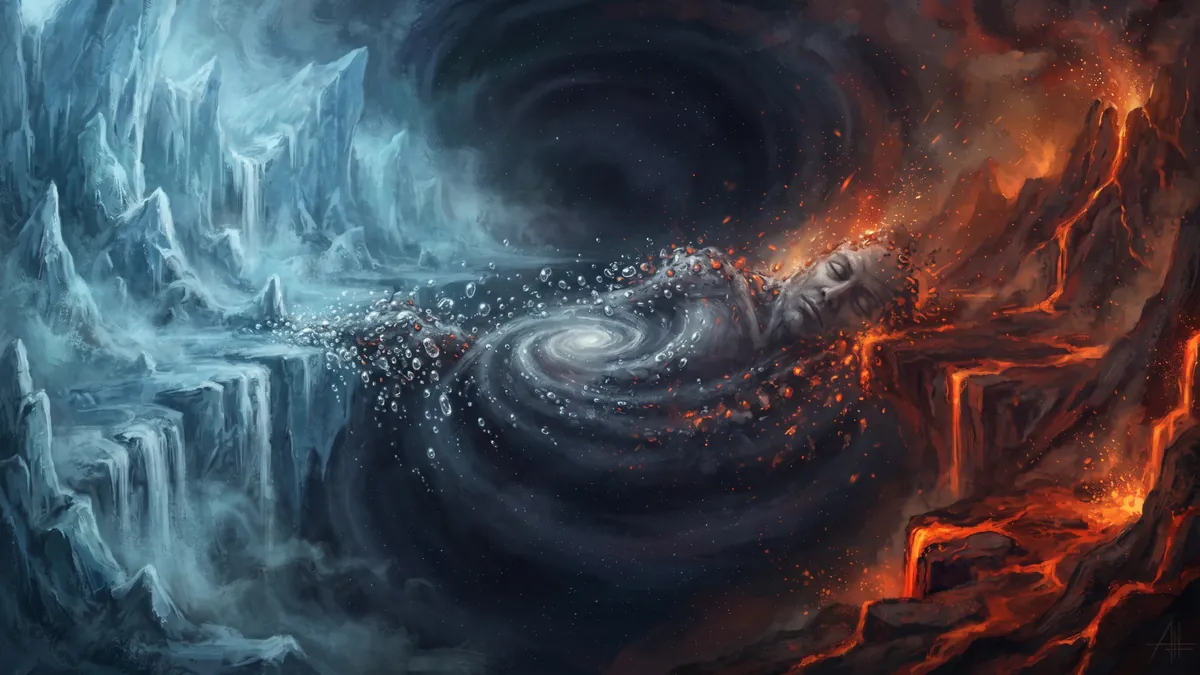
Before sky, earth and sea, what was there? In Norse mythology the answer has a name: Ginnungagap, the open void from which everything came.
The name
In Old Norse, Ginnungagap is usually translated “gaping abyss” or “yawning void”. The first part, ginnunga-, is generally tied to a verb meaning “to gape” or “to yawn”. But Wikipedia notes that this verb does not occur in Old Norse except in Völuspá verse 3, “gap var ginnunga”, which may be a play on the term.
Scholars do not agree on the origin. Ursula Dronke suggested the word was borrowed from Old High German ginunga, and notes that Múspell also seems to have been borrowed from that language. Another explanation links the prefix ginn- to sacred words, such as ginn-heilagr and ginn-regin, used of the gods, and ginn-runa, used of the runes. In that case Ginnungagap would be a “magical space full of creative power”.
Two texts
In Völuspá, a very old seeress, raised by giants, tells how Odin and his two brothers created the world from Ginnungagap.
The longest description is in Snorri’s Gylfaginning. In Brodeur’s translation, in chapters IV to VI, the order is this:
- To the north lies Niflheim, the world of mist, with the spring Hvergelmir at its centre, from which many rivers flow.
- To the south lies Múspell, a region of light and heat, guarded by Surtr, who has a flaming sword and will burn the world at the end.
- Between the two, the Void. The rivers, called “ice-waves”, carried venom that hardened into ice, and rime piled up over Ginnungagap.
- The northern side of the void filled with ice and rime. The southern side was lit by sparks flying from Múspell.
- Where the heat met the rime and melted it, life took shape from the drops, in the form of a man called Ymir. The rime-giants descend from him.
Next comes Auðumbla, the cow formed from the rime, who fed Ymir with four streams of milk and licked blocks of salty ice. On the first day a man’s hair appeared, on the second a head, on the third the whole man, Búri. Búri’s son Borr married Bestla, and their sons were Odin, Vili and Vé.
A name used in other poems
Wikipedia also records that Þjóðólfr of Hvinir plays on the term in his Haustlöng, with the phrase “ginnunga vé”. Dronke notes this.
From myth to map
Centuries later, the name left the poems and landed on maps. In the early fifteenth century, Scandinavian cartographers tried to place Ginnungagap in a real location. The fifteenth-century fragment Gripla, from before Columbus, puts it “between Vinland and Greenland”, linked to the sea called Mare oceanum. A note in a fifteenth-century manuscript of Adam of Bremen’s work cites “Ghimmendegop” as the Norse word for the abyss of the far north. In the seventeenth century the Icelandic bishop Guðbrandur Thorlaksson used “Ginnungegap” for a narrow body of water, possibly the Davis Strait, which separates southern Greenland from the land of Estotiland, probably Baffin Island.
What the sources do not say
Wikipedia does not mention, and so this text does not claim, what the void held before the ice and the fire. Snorri describes the meeting of the two extremes, but he does not explain where the Void came from.
In short
Ginnungagap is the open space between the ice of Niflheim and the fire of Múspell. In Snorri’s version, it is there that heat melts the rime and Ymir appears, ancestor of the giants. The exact meaning of the name is still debated.
To train your attention with the ice, the sparks and the drops, play Sparks for Ymir.
Sources.
- English Wikipedia, article "Ginnungagap", with the passages from Völuspá and Gylfaginning, the etymology and the late geographical identifications
- Snorri Sturluson, Gylfaginning (chapters IV to VI in Brodeur's 1916 translation)
- Ursula Dronke, The Poetic Edda, vol. II (1997); De Vries, Altnordisches etymologisches Wörterbuch (1977); Seaver, Maps, Myths and Men (2004), cited in Wikipedia