 MMXXVI
Gullveig, the one burned three times: the riddle in Völuspá before the war among the gods
In Völuspá, a figure called Gullveig is pierced with spears and burned three times in Odin's hall, and the next stanza tells the war between the Æsir and the Vanir. See what the poem says, what scholars propose and what remains unanswered.
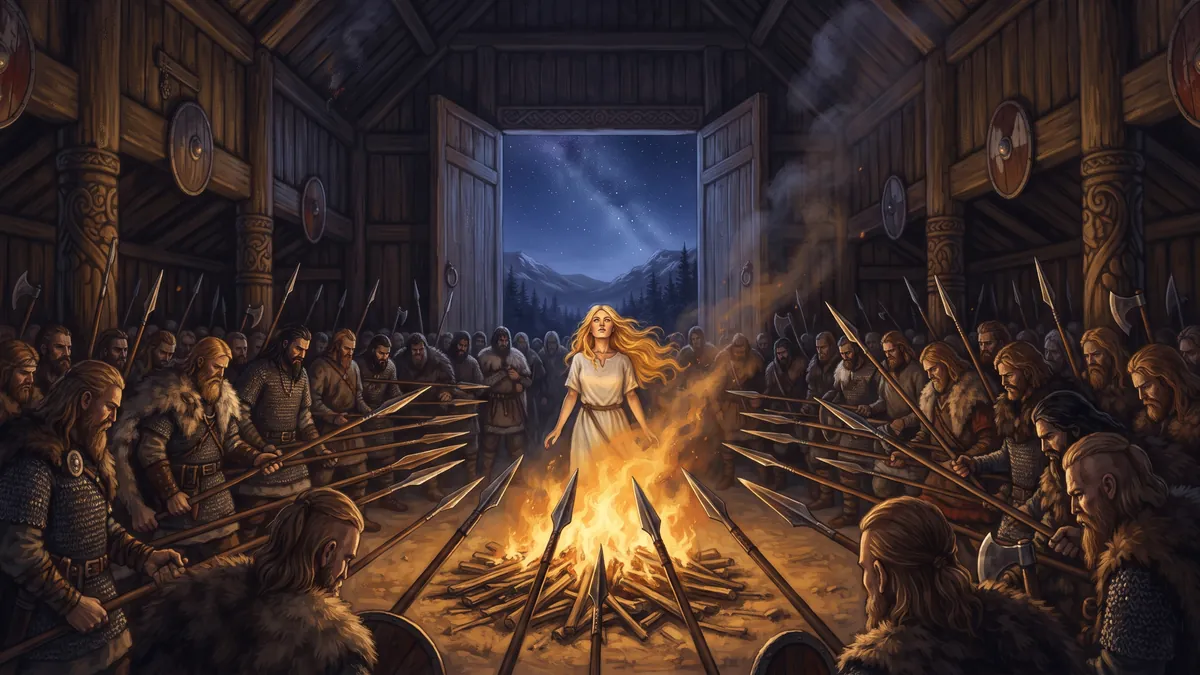
Among the lines of Völuspá there is a short and disturbing scene: a woman is pierced with spears, burned three times and still lives. Her name is Gullveig, and nobody knows for certain who she is.
What the poem says
Völuspá is the speech of a seeress, a völva. At one point she recalls the first great war in the world. Before telling the war, she says that Gullveig was pierced with spears and burned in the hall of Hárr, one of Odin’s names.
She was burned three times and reborn three times. And, says the seeress, she still lives.
After the burning she came to be called Heiðr, a völva of great knowledge who performed great feats. According to Wikipedia, the translations vary. Bellows, Orchard and Lindow use different words, and Heiðr appears as a “wide-seeing witch” in Bellows and as a seeress skilled in prophecy in Lindow.
Wikipedia does not give the stanza number, but says Gullveig’s treatment comes in the stanza immediately before the narration of the war between the Æsir and the Vanir.
The name
Gull means “gold”. The second element is uncertain. It has been proposed that it means power or strength, intoxicating drink, lady, or gold or gold thread. Translations of the name include “gold-drink”, “gold-drunk” and “gold-draught”. In some readings Gullveig is seen as gold itself, purified by repeated smelting.
Heiðr, in adjectival form, means “bright, clear”. Simek says the underlying meaning remains basically the same in both forms of the name.
What scholars propose
Wikipedia lists a few hypotheses and warns that they are proposals, not firm conclusions.
- She caused the war. Because her treatment comes right before the account of the war, some scholars think it may have led to it. Lindow suggests that her bringing of seiðr, Norse magic, to the Æsir was either a wartime strategy or what started it. He treats this as possible, not certain.
- She is Freyja. Turville-Petre, Simek and Lindow have theorized that Gullveig and Heiðr are Freyja. Orchard notes that Freyja is also associated with gold and seiðr.
- Gold corrupted the gods. Some propose that Gullveig’s death has to do with the corruption of the Æsir by gold.
What is not known
Wikipedia says outright that the etymology remains uncertain and that both the identification with Freyja and the idea that she caused the war are proposals. The passages Wikipedia summarises do not say why she was attacked or why she kept coming back to life.
In short
Gullveig is a figure of a few lines: pierced, burned three times, reborn, then called Heiðr. What she does and what she means remain open. The scene is read as a possible start of the war between the Æsir and the Vanir, but scholars still debate whether she is gold itself, a form of Freyja or a witch who taught magic to the gods.
To train your reasoning with the flames and the halls, play The hall of gold.
Sources.
- English Wikipedia, article "Gullveig", with the Völuspá passages and the scholars' hypotheses
- Völuspá translations by Bellows, Orchard and Lindow, compared in Wikipedia
- Rudolf Simek, John Lindow, Turville-Petre and Andy Orchard, cited in Wikipedia