 MMXXVI
Gunnar of Hlíðarendi: the man who turned back home and the bowstring that was never mended
In Njáls saga, Gunnar accepts leaving Iceland for three winters, looks at his hillside, says he has never found it so fair, and stays. See the order of the chapters, from Njáll and the settlements to the last defence at Lithend, according to Dasent's translation.
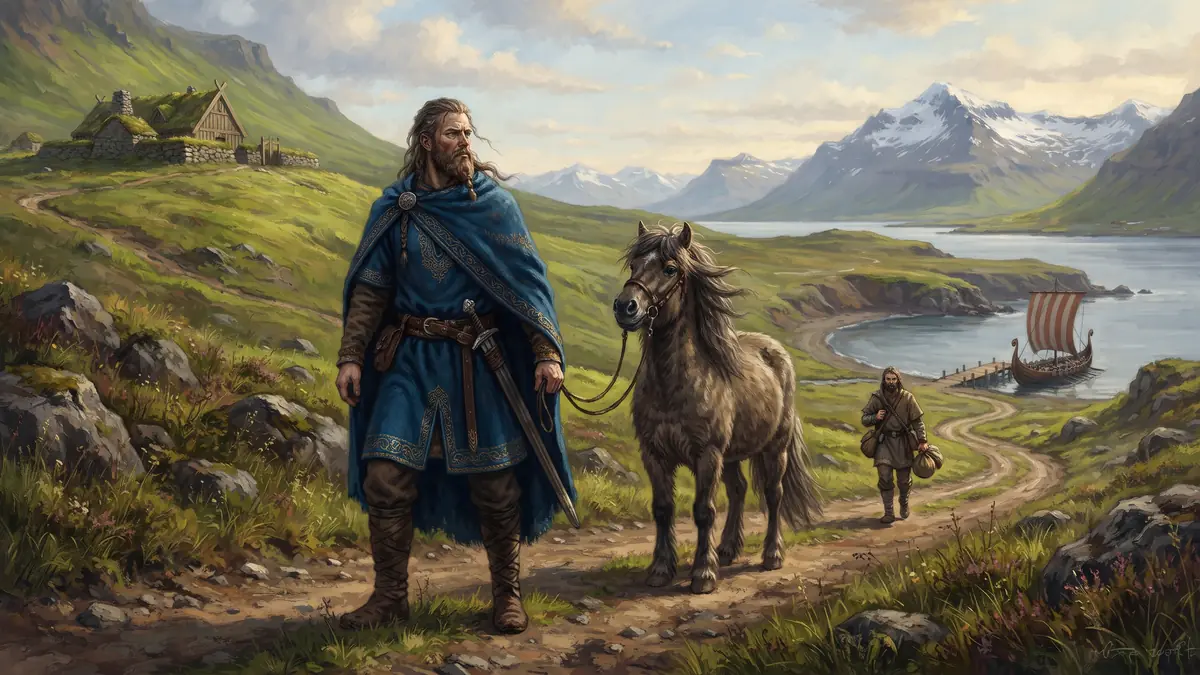
Gunnar Hámundarson is one of the best remembered heroes of the Icelandic sagas, and the most famous scene of his life is a look back. Here is the order in which Njáls saga tells it.
Who Gunnar was
Gunnar was a tenth-century chieftain of Hlíðarendi, in Fljótshlíð, in southern Iceland. His best friend and adviser was Njáll Þorgeirsson of Bergþórshvoll. He married Hallgerðr Höskuldsdóttir, known as Hallgerðr langbrók. She was his third wife, according to Wikipedia, and Njáll saw the marriage as imprudent.
The slap
In ch. 48, in Dasent’s translation, the servant Malcolm steals food from the neighbouring farm on Hallgerðr’s orders. When the food appears on the table, Gunnar slaps her on the cheek. The saga does not forget the slap.
Njáll’s warning
In ch. 55, Njáll advises Gunnar never to slay more than one man of the same family. In ch. 72, after Gunnar has killed two people of the family of Gizur the White, Njáll repeats the warning: “now hast thou slain twice in the same stock”. Gunnar says he does not intend to break a settlement, but asks Njáll’s help at the Thing.
The sentence
Gizur prosecutes Gunnar for manslaughter and asks that he be declared an outlaw, with forfeiture of his goods. Njáll manages to bring about a settlement (ch. 73). Twelve men decide the payment. Gunnar must leave the country with his brother Kolskegg for three winters. If he does not leave when he has a passage, the kinsmen of the dead may slay him.
“Fair is the hillside”
In ch. 74, as he rides towards the ship, Gunnar’s horse stumbles. He looks at Lithend, his farm, and says: “Fair is the Lithe, so fair that it has never seemed to me so fair.” He says he will ride back and not leave.
Kolskegg answers that he should not give his foes that joy and that Njáll’s prediction will come true. Kolskegg says he will not go back on his word, and goes on to the ship. Gunnar returns to Lithend and spends the winter with few men.
The siege
His enemies give notice of Gunnar’s outlawry at the next Thing. About forty men form a league against him, and Mord Valgardsson watches for an opportunity. Njáll offers to send Skarphedin and Hauskuld to guard him, but Gunnar refuses, not wanting to see Njáll’s sons die for him.
In ch. 75, Mord sends word that Gunnar is alone at home, because his servants are haymaking at the isles. The enemies force the neighbour Thorkell to lure away Gunnar’s hound, Sam, who would give the alarm. The hound attacks Thorkell and is killed with an axe blow to the head.
The death
In ch. 76, Gunnar sleeps in a loft above the hall with Hallgerðr and his mother. When Thorgrim the Easterling climbs onto the roof, Gunnar thrusts at him with his bill, a polearm, and Thorgrim falls and dies. Gunnar shoots arrows and holds off several assaults. Then Thorbrand cuts his bowstring.
Gunnar asks Hallgerðr and his mother to twist locks of her hair into a new string. Hallgerðr answers by recalling the slap and says she does not care whether he holds out a long or a short while. Gunnar keeps fighting, wounded many times, until he is killed. Gizur says the defence will be remembered, and the killing is ill spoken of throughout the country.
The cairn
In ch. 77, Gunnar is buried in a cairn, seated upright. Rannveig will not let his bill be buried with him. Herdsmen see Gunnar merry inside the cairn, and Skarphedin and Hogni also see him, with lights and no shadows. The saga says he sings inside. This text does not reproduce the song.
In short
The central scene has no great combat: it has a man who looks at his own home and chooses to go back. The saga shows what that costs. Whoever wants the exact scene should read Dasent’s translation, cited above.
To train your aim and attention with the arrows, play Target shooting at Lithend.
Sources.
- Njáls saga (Brennu-Njáls saga), English translation by George Webbe Dasent, The Story of Burnt Njal, Project Gutenberg, ch. 48, 55 and 72 to 78
- English Wikipedia, article "Gunnar Hámundarson"
- Hurstwic, page "Gunnar Hámundarson", for the marriage, the death and the closing remark of his enemies