 MMXXVI
Kjartan, Bolli and Guðrún: the triangle of love and revenge in Laxdæla saga
In Laxdæla saga, two cousins raised together compete for the same woman, Guðrún, and the friendship ends in death. See the plot, Ingibjörg's headdress and Guðrún's last line: "To him I was worst whom I loved most."
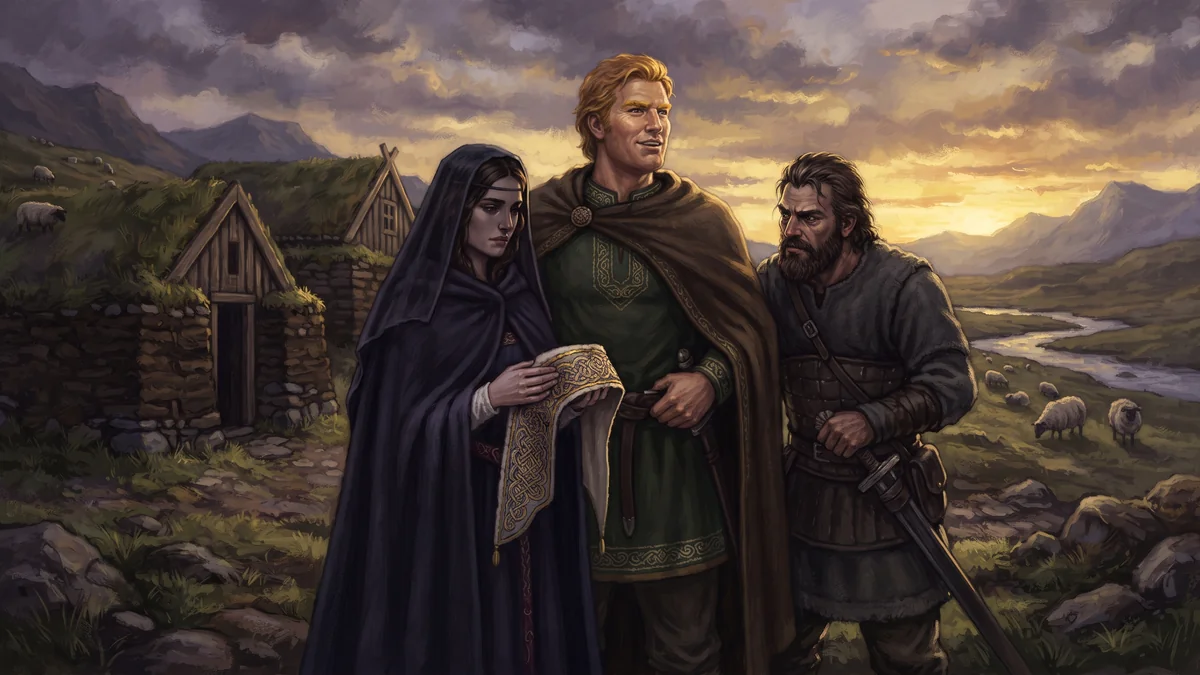
Laxdæla saga is one of the most widely read Icelandic sagas, and at its centre is a triangle: two cousins who grew up together and the woman they both wanted. What begins as friendship ends in two deaths.
The characters
Kjartan Ólafsson is the son of Olaf the Peacock and Þorgerðr. He is handsome and proud. Bolli Þorleiksson is the son of Þorleikr, Olaf’s half-brother, and was raised by Olaf as a foster-son. Guðrún Ósvífrsdóttir is described as the most beautiful and clever woman raised in Iceland. She marries four times.
The quarrel before the voyage
Kjartan and Bolli grow up as close friends. Kjartan and Guðrún grow close and everyone thinks them well matched. When the two men plan to go abroad, Guðrún asks to go with Kjartan. He refuses, citing her duties at home, and asks her to wait three years. She does not accept, and they part in anger.
Norway
In Nidaros, Kjartan and Bolli find that Olaf Tryggvason now rules Norway and presses for Christianity. The Icelanders who refuse to convert are stuck in port. Kjartan first proposes burning the king’s quarters with the king inside, but later warms to Olaf and accepts baptism, as do the other Icelanders. The king holds Kjartan and other sons of prominent Icelanders as hostages, to press Iceland to convert. Kjartan becomes friends with the king’s sister, Ingibjörg. Bolli is released early and goes home.
Bolli’s marriage
Bolli tells Guðrún that Kjartan is favoured by the king, will not return soon, and has grown close to Ingibjörg. Then he asks for her hand. Guðrún is reluctant, but the marriage goes ahead.
Ingibjörg sends Kjartan back with an embroidered headdress meant as a wedding gift for Guðrún. Kjartan learns that she is already married. He finds Hrefna trying on the headdress, gives it to her and marries her.
The quarrel grows
The text describes the sequence at Bolli’s and Guðrún’s home:
- Bolli offers Kjartan fine horses, and Kjartan refuses.
- At a feast, Kjartan seats Hrefna in the high seat, which Guðrún had long held. She is visibly upset.
- Kjartan’s sword is stolen and found in a swamp without its scabbard. Guðrún’s brother is suspected. Olaf persuades Kjartan to drop the matter.
- Hrefna’s headdress vanishes at the next feast. Kjartan accuses Bolli. Guðrún replies that anyone involved would have taken only what was rightfully theirs.
- Kjartan besieges Bolli’s farm, posting guards at every door for three days. Then he blocks a land purchase that Bolli and Guðrún had planned.
The killing of Kjartan
Guðrún urges her brothers to ambush Kjartan and wants Bolli to join. Bolli refuses at first, citing Olaf’s kindness and his kinship with Kjartan. Guðrún threatens divorce, and he relents. When Kjartan is found with a single companion, the brothers attack. Bolli stands aside until they fear Kjartan will escape and press him. Bolli draws his sword. Kjartan throws down his weapon, and Bolli kills him. Then he holds him as he dies.
Afterwards
Guðrún’s brothers are exiled at the assembly. Olaf asks that Bolli pay a fine instead of being outlawed. Three years later, when Olaf dies, Þorgerðr urges her sons to revenge, and they kill Bolli. Helgi wipes his spear on Guðrún’s shawl, and she smiles. Her son, Bolli Bollason, avenges his father and later serves in the Varangian Guard in Constantinople.
Guðrún marries a fourth time, is widowed again, and becomes a nun and anchorite in old age. In the last chapter, Bolli Bollason asks which husband she loved most. She resists answering and, in the end, says: “To him I was worst whom I loved most.”
In short
The saga was written in the thirteenth century, between 1230 and 1260 by internal evidence, by an unknown author. The oldest complete manuscript is Möðruvallabók, from the mid-fourteenth century. Only Njáls saga survives in more manuscripts.
To match each act to the right character, play Every act to its character.
Sources.
- English Wikipedia, article "Laxdæla saga", with the plot, the dating and the manuscripts
- Laxdæla saga, thirteenth-century Icelandic text, preserved in Möðruvallabók (mid-fourteenth century), according to Wikipedia