 MMXXVI
Lord Peter: the Norwegian tale of the cat who made the youngest son pass for a lord and tricked a troll with a story about rye
In "Lord Peter", by Asbjørnsen and Moe in Dasent's translation, the heir to a cat sends deer to the king, leads the king to a silver castle and holds off the troll who owns it until sunrise. See the sequence and what Dasent's introduction says about the tale.
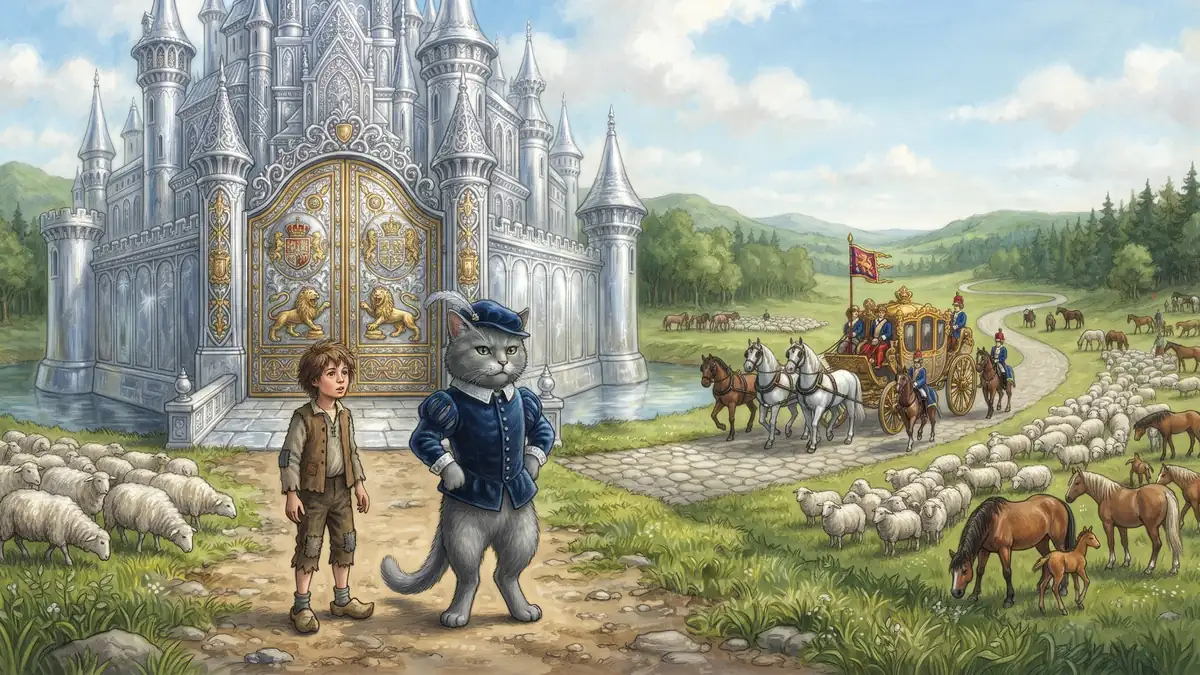
If you know “Puss in Boots”, you will recognize the start. But in the Norwegian version the cat hides a surprise at the end.
The inheritance
A poor couple have three sons. When the parents die, the brothers divide the inheritance: the eldest takes the porridge-pot, the second the griddle, and the youngest, Peter, gets the cat.
The deer
The cat sends Peter to the king three days in a row. Each time he brings a deer that she herself has forced to the palace. Peter says the gift is from “Lord Peter” and does not say where he lives.
The visit to the castle
The king asks Peter to bring Lord Peter to visit. The cat promises a coach, horses and clothes.
The king comes. Peter says he has finer things at home. The cat leads the two past a flock of sheep, a herd of kine and a drove of horses. At each place the herdsmen, bribed with silver objects, say that everything belongs to Lord Peter.
They reach a silver castle with tin, silver and gold gates. The king is downcast. Then the troll who owns the castle arrives.
The rye
The cat holds the troll with a long story about winter rye until sunrise. With the sun, the troll bursts.
The end
Afterwards the cat asks Peter to cut off her head. He does, and she becomes a princess who had been bewitched by a troll. She marries Peter, and the wedding lasts eight days.
Who does what
The cat invents everything. Peter does what the cat tells him: he goes to the king, gives the name “Lord Peter” and, at the end, cuts off the cat’s head.
Dasent’s introduction
In the book’s introduction, Dasent calls the tale “the full story” of Puss in Boots. He says the cat is a princess bewitched by a troll who robbed her of her lands. And he cites the scene in which the cat tells the story of winter rye to a giant’s wife.
What differs from Puss in Boots
- The cat is a woman, and not only a clever animal.
- The enemy is a troll, who dies in the sun.
- At the end the cat asks to be killed, and that breaks the spell.
What stays unanswered
The tale does not explain how the troll could bewitch the princess or why the spell is undone only by cutting off her head. What it shows is what the cat does for Peter, and what the cat gets in return.
In short
“Lord Peter” is a tale of cunning, in which the heir to almost nothing gains a castle thanks to a cat. The sun, which makes trolls burst, is the final weapon.
To train your attention with the deer, the herds and the castle gates, play Silver for the shepherds.
Sources.
- Peter Christen Asbjørnsen and Jørgen Moe, in George Webbe Dasent's English translation, "Lord Peter", in Popular Tales from the Norse (Project Gutenberg)
- Dasent's introduction in the same book, which calls the tale "the full story of Puss in Boots"