 MMXXVI
Shortshanks and the three one-eyed hags: the Norwegian tale of the three gifts
In "Shortshanks", a tale by Asbjørnsen and Moe, a boy steals the eye of three hags and gives it back only in return for three gifts: a sword, a ship and the art of brewing. See what each gift does, in Dasent's translation.
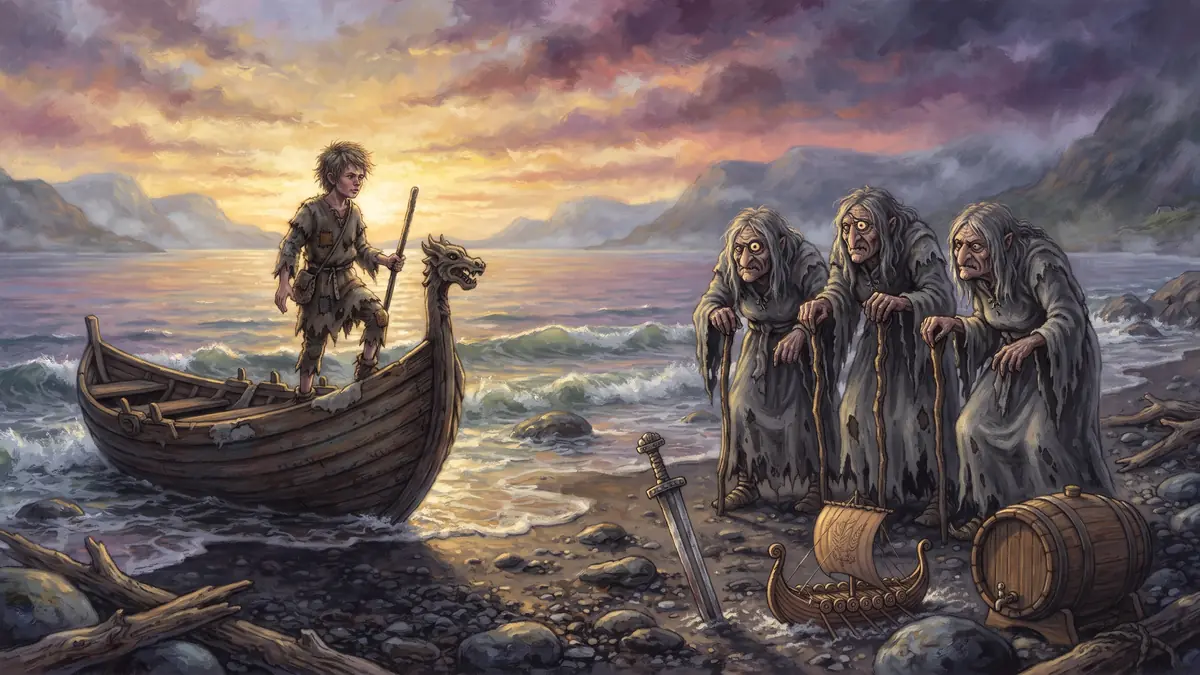
Among the tales Asbjørnsen and Moe collected in Norway, “Shortshanks” is one of the most full of twists. In George Webbe Dasent’s translation, it has twin brothers, three one-eyed hags, three ogres and a cowardly knight. And almost everything turns on three gifts.
The twins
Shortshanks is the younger of two twins, born to a poor couple who already have many children. The first twin leaves home at birth, and Shortshanks follows him out. The two choose their names: the elder will be King Sturdy, and the other Shortshanks. After parting and meeting again several times, they agree to go east and west. King Sturdy tells his brother to call on him up to three times, but only in his utmost need.
The three hags and the three gifts
Shortshanks meets three one-eyed, crook-backed hags, steals each one’s eye and bargains for its return. Each gives a gift:
- A sword: “such a sword! It will put a whole army to flight.”
- A ship, which can sail over fresh water and salt water, and over high hills and deep dales. It shrinks to pocket size and grows when Shortshanks steps in.
- The art of brewing a hundred lasts of malt at one strike, a last being an old measure of cargo.
The order is always the same: sword, ship, brewing. And each gift serves one episode of the tale.
The kitchen boy and the ogres
Shortshanks sails to the king’s palace, which is hung with black for mourning. He is taken on as a ragged boy who carries wood and water for the kitchen-maid. She tells him that the king’s daughter is promised to three ogres, one each Thursday evening.
The knight Ritter Red escorts the princess to the strand and, each time, hides in a tree. Shortshanks slips away to the strand on the pretext of playing and, with the sword, kills the ogres one by one: the five-headed, the ten-headed and the fifteen-headed. Each time the princess covers the sleeping boy with a robe: first of tinsel, then of silver, then of gold. Ritter Red comes down from the tree, threatens the princess into saying he saved her and cuts out the ogres’ lungs and tongues as proof.
The wedding and the second rescue
At the wedding, the princess insists that the ragged boy be her cup-bearer. Shortshanks spills drink on Ritter Red’s plate, and Ritter Red strikes him three times. Each blow knocks off a layer of the boy’s clothing, until the golden robe shows. The princess declares that it was he who saved her, and Ritter Red is thrown into a pit of snakes.
The king’s other daughter has been carried off by an ogre under the sea. Shortshanks uses the ship, which grows to hold five hundred men and an iron cable, and dives to a rock with a door, where the princess sits sewing. The ogre needs someone to brew a hundred lasts of malt at one strike. Shortshanks uses the third art and makes the wort so strong that the ogre and his kin die after drinking it.
The ending
Both princesses want to marry Shortshanks, but he loves the younger. He calls King Sturdy three times, which annoys his brother, who gives him a box on the ear. The brothers swap clothes, the elder princess kisses King Sturdy and takes him as husband, and the younger goes to Shortshanks.
In short
“Shortshanks” is a Norwegian tale by Asbjørnsen and Moe, in Dasent’s translation. The three hags’ gifts are the sword that puts armies to flight, the ship that shrinks and grows and the art of brewing a hundred lasts of malt at one strike, in that order. With them, the boy kills the ogres, exposes the lying knight and rescues the second princess.
To repeat the order of the hags’ three gifts, play The hags’ three gifts.
Sources.
- Asbjørnsen and Moe, "Shortshanks", in Popular Tales from the Norse, translated by George Webbe Dasent, tale XX, Project Gutenberg no. 8933