 MMXXVI
Sonatorrek, the irreparable loss of sons: the poem of mourning Egill composed so as not to starve
In Egils saga, the poet loses two sons, wants to let himself die and is persuaded by his daughter to compose a poem. See what Wikipedia says about Sonatorrek's structure, its metre, its references to Odin, Ægir and Rán, how it reached us and what scholars say of it.
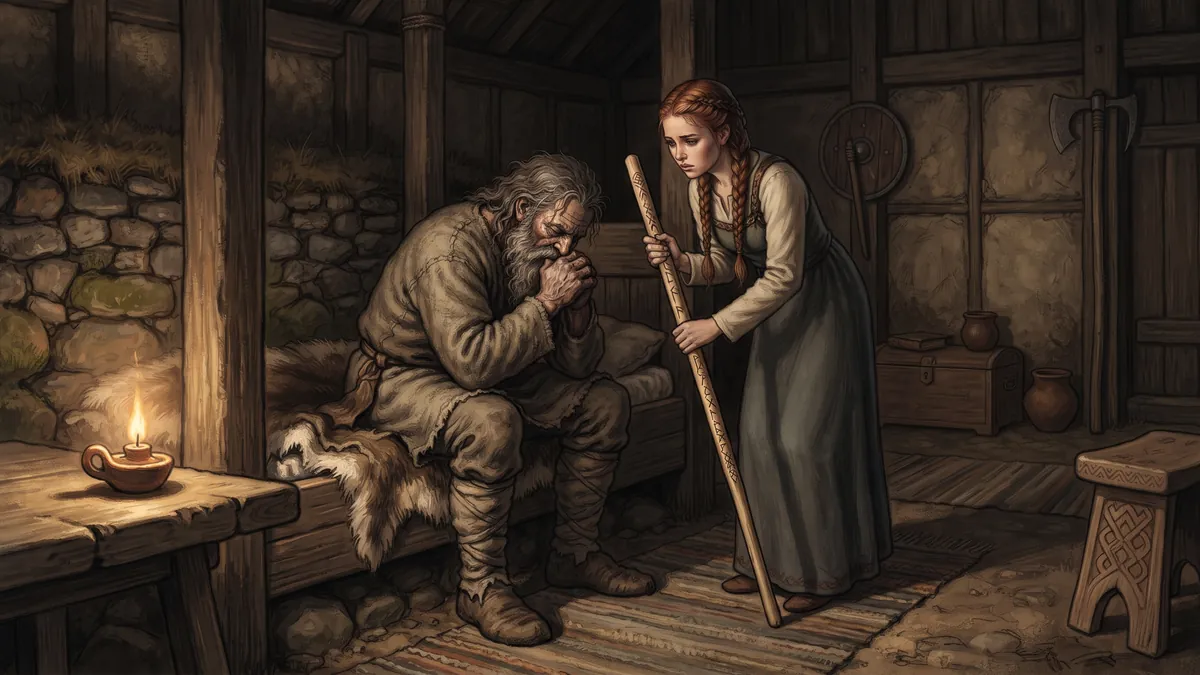
Egill Skallagrímsson is remembered as a poet, a warrior and a difficult man. But his most discussed poem is one of the most intimate in Norse poetry: Sonatorrek, “the irreparable loss of sons”.
The context
Sonatorrek is a skaldic poem of 25 stanzas, preserved in Egils saga, written c. 1220 to 1240. It mourns two of Egill’s sons: Gunnar, who died of a fever, and Böðvarr, who drowned in a storm.
In the saga, after Böðvarr is placed in the family burial mound, Egill shuts himself in his bedchamber intending to starve to death. His daughter Þorgerðr talks him out of it, partly by persuading him to compose a memorial poem, to be carved on a rune-staff.
How the poem reached us
The first stanza appears in all the main medieval manuscripts of the saga, or in copies made when they were more complete. Only the K-manuscripts preserve the whole poem. K is lost and survives through two nearly identical copies by Ketill Jörundsson. Snorri’s Edda contains the first half of stanza 23 and all of stanza 24. Bjarni Einarsson says the text is the product of many copies and is in places corrupt beyond correction.
The metre
The poem uses kviðuháttr, a variant of fornyrðislag. Odd lines have three metrical positions instead of four, and even lines follow the usual pattern. There is systematic alliteration, with no rhyme. Egill used the same metre in his praise-poem Arinbjarnarkviða.
Seven parts
Wikipedia describes the structure like this:
- Stanzas 1 to 4: Egill struggles to find words for grief and laments the end of his family line. Stanza 4 introduces the wood and tree imagery that runs through the poem.
- Stanza 5: he recalls the deaths of his parents.
- Stanzas 5 to 12: grief for Böðvarr, with the image of the sea breaking a gap in the “fence of his kinsmen”. He wants vengeance on the sea-deities Ægir and Rán but, old and without followers, feels powerless.
- Stanzas 13 to 19: he recalls the death of his older brother Þórólfr. Since then he has felt lonely and without support in combat.
- Stanzas 20 and 21: he briefly recalls Gunnar, his first son, who died of fever.
- Stanzas 22 to 24: he turns against Óðinn, with whom he had been on good terms until the god broke the friendship. On reflection he recognizes two compensations: the craft of poetry and the ability to turn deceivers into open enemies.
- Stanza 25: Egill reconciles himself to the loss and awaits death calmly.
The gods in the poem
The poem has about twenty allusions to Norse gods and myths, some of which cannot be fully understood. In stanza 25 death is personified as the goddess Hel, waiting on a headland, an image Wikipedia singles out as especially striking. Some scholars have suggested Egill modelled the poem and his grief on the myth of Odin mourning his son Baldr.
What scholars say
Margaret Clunies Ross says the poem has probably received more literary praise since the late nineteenth century than any other single skaldic poem. Peter Hallberg calls it “generally regarded as the first purely subjective lyric in the North”. Carolyne Larrington speaks of “a poem of unparalleled psychological depth, poetic self-awareness and verbal complexity”.
What this text does not do
It does not reproduce the verses. What matters here is the structure and the context.
In short
Sonatorrek is the poem of a father who lost two sons, written, according to the saga, so that he would not let himself die. It moves from grief to anger at the gods and to a final calm. The text has gaps, but it is one of the most praised skaldic poems.
To train your memory with the images of the sea, the tree and the fence, play The fence of kin.
Sources.
- English Wikipedia, article "Sonatorrek", with the seven-part structure, the metre, the manuscript transmission and the views of scholars
- Egils saga Skalla-Grímssonar, written c. 1220 to 1240, cited in Wikipedia
- Margaret Clunies Ross, Peter Hallberg and Carolyne Larrington, cited in Wikipedia