 MMXXVI
The Blue Belt: the Norwegian tale of the poor boy who found a belt, beat a troll and danced as a bear to find the princess
In the tale "The Blue Belt", by Asbjørnsen and Moe in Dasent's translation, a beggar woman's son ties on a belt found on the road and gains enormous strength. See the sequence: the troll, the lions' milk, the castle, the blindness, the hare's spring and the hidden princess.
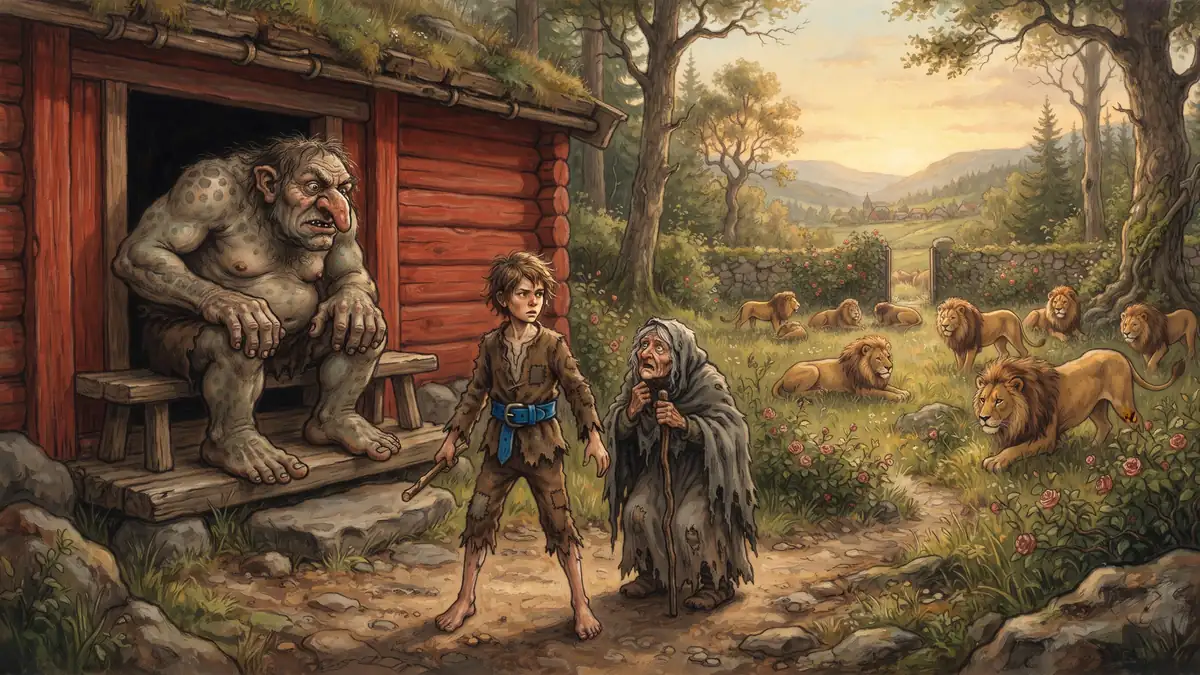
A small belt, found on the ground, and a boy who suddenly can lift a hill. That is how “The Blue Belt” begins, one of the tales of Asbjørnsen and Moe that Dasent translated into English.
The belt
An old beggar woman and her young son are heading home over the hills with a full bag. At a crossroads the boy wants to pick up a small blue belt. His mother forbids it, because “maybe there’s witchcraft in it”. The boy slips back, takes the belt and ties it round his waist. Suddenly he feels strong enough to lift the whole hill.
The troll’s house
Night falls and the mother tires. The boy climbs a crag, sees a light to the north and carries his mother and the bag up a steep spur. They reach a red house where a giant troll sits on a bench. The mother swoons, and the boy calls the troll “grandfather”, which pleases him.
The troll burns pitch-pine, roasts a whole ox and serves it on a silver dish, with a cask of wine and giant knives. He eats the entire ox, drains the cask and gives the boy a cradle to sleep in.
The three traps
The troll and the old woman plan to kill the boy.
- The rock. The troll takes him to quarry stones and sends a rock down on him. The boy shifts the troll beneath it, and the rock breaks the troll’s thigh. The boy carries him home.
- The lions’ milk. They send the boy for milk from twelve lions in a garden. He beats the biggest, and the rest cower. When the troll calls the milk a lie, the lions seize him.
- The apples. They send him to an orchard near the castle of the troll’s brothers, where the apples cause three days of sleep. The lions guard him, and the brother trolls who arrive are torn apart.
In the castle the boy meets the King of Arabia’s daughter, held captive by the trolls. He proves strong enough to wield the trolls’ giant sword. She later sails home, and he, remembering his mother, goes back to visit her.
The betrayal and the spring
His mother and the troll take the belt from him and take his sight. They set him adrift in a boat. The lions swim after him and carry him to an island, where he is blind and eats raw meat.
A blind hare runs into a spring and regains its sight. The lion dips the boy in the same spring, and his sight returns. He goes back to the castle, takes the belt from the kitchen, and kicks and stamps until his mother comes out. He gives her the punishment she had made him suffer and then leaves the troll without sight, in a boat, alone.
The voyage to Arabia
He sets out with four ships. On an island they crack a giant egg, and a huge chicken is released. The sailors reach Arabia in record time, and a giant bird drops an island onto the fleet. The boy kills it with his sword.
The dancing bear
The King of Arabia has hidden his daughter and promised her to whoever finds her. The boy disguises himself in a white bear-skin and dances as a performing bear. At midnight the king takes the bear to a floating house on a pier, where the princess is hidden. She recognizes him, and in the morning the boy puts the skin back on.
Dressed as a prince, he has 24 hours to find her or lose his life. He dances while the hours pass and, at the last moment, leads the king through the galleries to the pier. When the king stalls with his keys, the boy kicks the door in. The princess claims him, and the beggar boy marries the king’s daughter.
An echo of Thor
In the book’s introduction, Dasent says the belt gives the boy great strength and that the boy who overcomes the troll resembles Thor in one of his battles with the giants.
In short
The tale joins in a single plot a magic belt, a troll, lions, a healing spring and a dancing bear. What stands out is that the boy wins by using the belt’s strength and his wits, and the final victory comes from a disguise, not from a fight.
To train your attention with the belt, the lions and the spring, play The boy’s hill.
Sources.
- Peter Christen Asbjørnsen and Jørgen Moe, in George Webbe Dasent's English translation, "The Blue Belt", in Popular Tales from the Norse (Project Gutenberg)
- Dasent's introduction in the same book, which compares the boy in the tale with Thor fighting giants