 MMXXVI
The Deacon of Myrká: the Icelandic tale of the dead bridegroom who rides on Christmas Eve
A deacon promises to return on Christmas Eve to fetch his sweetheart. He has drowned in the river, but he appears anyway. See the Icelandic tale, the sleeve that saved Guðrún and where this kind of story comes from.
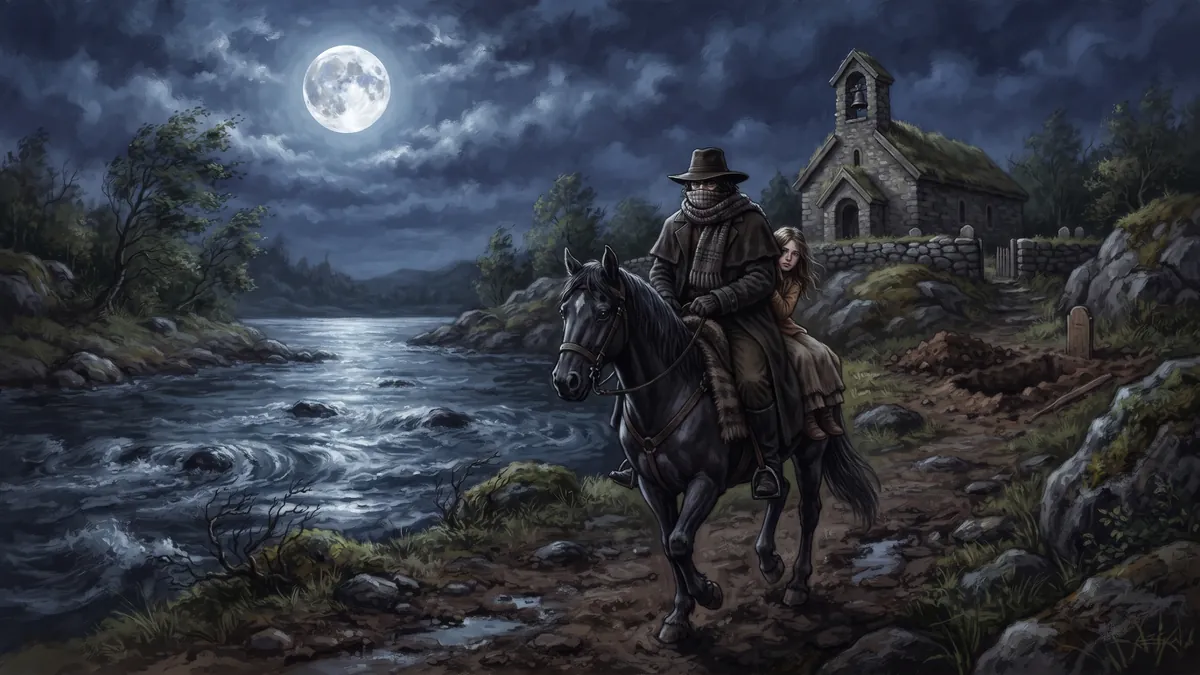
The Deacon of Myrká (Djákninn á Myrká) is one of the best-known ghost tales in Iceland. It is set in the north of the island, at Myrká, in Eyjafjörður. And it has a date that makes it perfect for telling: Christmas Eve.
The promise
The deacon lives at the farm of Myrká. Guðrún, his sweetheart, lives at Bægisá, across the river Hörgá. He rides his horse Faxi there to plan Christmas and promises to return on Christmas Eve to take her to Myrká.
On the way home, a storm catches him. He falls into the Hörgá, suffers a severe head injury and drowns. A farmer finds the body the next day, and the burial is a week before Christmas. Guðrún never hears of it.
The eve
On Christmas Eve, the deacon arrives as promised. Guðrún has time to put on only one sleeve of her coat before they leave. He keeps his face hidden under a hat and a scarf.
At the Hörgá, the horse stumbles and the deacon’s hat falls forward. In the moonlight, Guðrún sees the wound on his head. He asks whether she sees the white spot on the back of his head. She answers that she sees it, but does not understand.
At Myrká, he tells her to wait while he moves Faxi over the fence. In the graveyard she sees an open grave and senses him trying to pull her into it. He seizes the empty sleeve of her coat, but, since she had put on only one, Guðrún slips free. With her other hand, she grabs the church bell rope and rings until people come out. The coat tears in two, and the deacon sinks into the grave holding half of it. Only then does she understand that she had met a ghost.
The ghost still haunts the night and disturbs others on the farm. An exorcist is summoned and lays it to rest.
The ghost who gets her name wrong
Wikipedia notes that ghosts in Icelandic folklore often speak in verse, repeating the last word of each line. Two of the deacon’s lines are quoted: “The moon fades, death rides” and “Wait here Garún, Garún”. The explanation for the second “Garún” is that he cannot say “Guð”, the first part of her name, because Guð means God, and ghosts in Icelandic legend cannot say words such as God or angel.
Where it comes from
The tale was first printed by Konrad Maurer in 1860, and in Icelandic by Jón Árnason and Magnús Grímsson in 1862. It is classified as ATU 365, “The Dead Bridegroom Carries Off His Bride”, a type in which the dead lover returns on a moonlit ride to take his beloved to the grave. Wikipedia lists Lenore and Sweet William’s Ghost as related works. The origin and author of the tale are unknown, and variants of the type were collected in both eastern and western Europe.
In short
A deacon drowns, but keeps his promise to fetch his sweetheart on Christmas Eve. Guðrún escapes only because she put on one sleeve of her coat, and she manages to ring the bell. It is a tale of a type known across Europe, which Iceland made its own, with a horse, a river, a ghost who gets her name wrong and a graveyard in the background.
To bar the door in time, play The door against the deacon.
Sources.
- English Wikipedia, article "Djákninn á Myrká", with the summary of the tale, its publication history and the ATU 365 classification
- Konrad Maurer, Isländische Volkssagen der Gegenwart (1860), first publication, according to Wikipedia
- Jón Árnason and Magnús Grímsson, Íslenzkar þjóðsögur og æfintýri (1862), first publication in Icelandic, according to Wikipedia