 MMXXVI
The great oak of the Kalevala and the tiny man who came out of the sea to fell it
In the second rune of the Kalevala, a giant oak hides the sun and moon until a tiny hero from the sea fells it in four strokes. See the episode and what comes after it.
The Kalevala is the Finnish epic that Elias Lönnrot put together from folk songs. The second canto (runo) begins after the creation of the world: the earth exists, but it is bare. Something must be planted. And, in the middle of the sowing, a problem the size of a tree appears.
Who sows
Väinämöinen, the old singer, has nobody to plant his empty island. He chooses Pellervoinen, also called Sampsa, a boy. Pellervoinen sows fir, pine, birch, alder, linden, willow, mountain-ash, hawthorn and juniper, and the forest grows. Only the oak does not sprout. Väinämöinen waits and looks again.
The oak
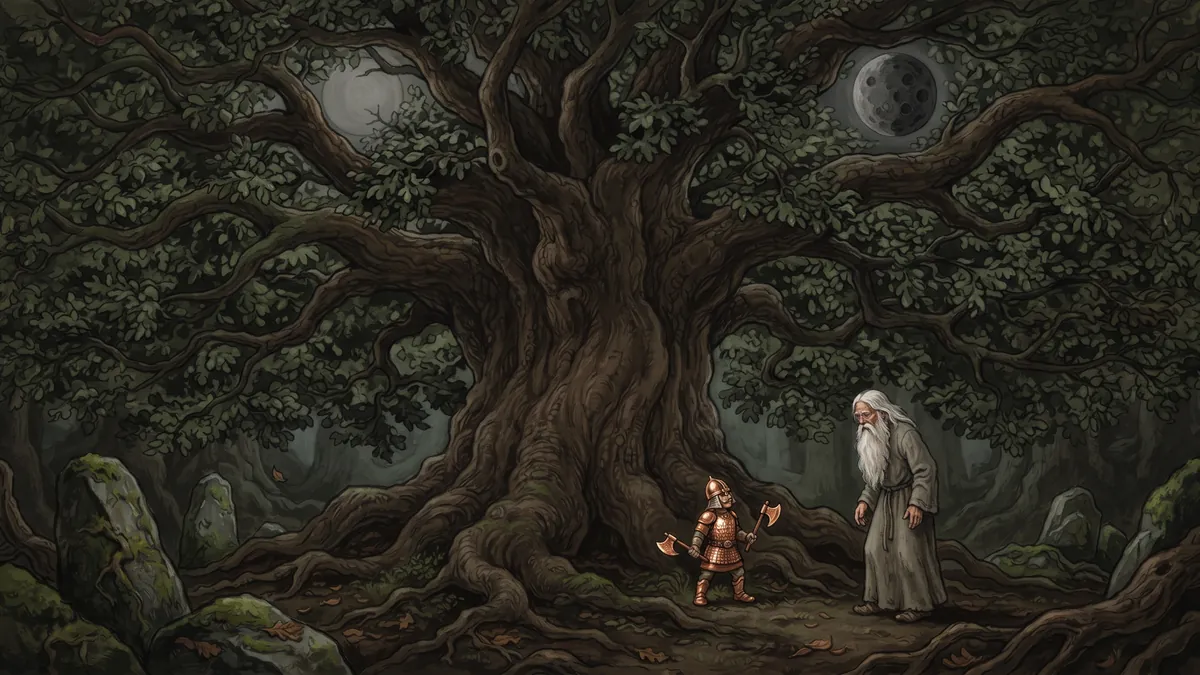
In Crawford’s translation, a giant named Tursas rises from the sea and sets fire to the grass that the water-maidens had raked into windrows. The ashes enrich the soil, and an acorn planted there becomes an enormous oak with a hundred branches. But the oak grows too much. Its branches shut out the light of the sun and moon, stop the white clouds on their paths and dim the starlight.
The tiny man
Väinämöinen asks the powers of the waters for help. From the ocean rises a small hero in copper armour. Väinämöinen doubts him, but the man grows until he is a giant, sharpens his axe on stones and fells the oak in four strokes. The last one brings it down.
The chips and splinters drift across the sea. A maiden of Pohjola gathers them and makes them into enchanted arrows and weapons. With the oak on the ground, the sun and moon shine again, the forests renew themselves and the birds sing.
The barley
But the barley still does not grow. Väinämöinen finds the seeds on the shore: the text speaks of six, or even seven kernels, not three. A titmouse warns him that the barley will only thrive if the land is cleared and burned. He cuts down the forest and leaves only the birch standing. An eagle sets fire to the rest, and the ashes are left for the fields.
Väinämöinen sows and asks the earth and Ukko, the god of the sky, for help. Ukko sends clouds that bring rain. The barley sprouts, with triple-knotted blades and six-sided ears. The canto ends with a cuckoo singing in the birch that Väinämöinen spared.
A myth of clearing the world
The episode works as a small origin story for a landscape: a tree that is too big is cut down, the fields receive ashes and the barley comes. Instead of an all-powerful god, the one who solves it is a small figure who grows, which is typical of many folktales. Another thing worth noting is the spared birch, where the cuckoo sings, a detail the text leaves as its closing.
In short
In rune 2 of the Kalevala, Pellervoinen sows the forest, a giant oak covers the sky and a tiny hero from the sea fells it in four strokes. Then come the burning of the woods, Ukko’s rain and the barley, with the cuckoo in the birch that was left. The text gives the details, and the translation used here is Crawford’s.
To gather the oak chips, play The oak chips.
Sources.
- Elias Lönnrot, Kalevala, rune 2 ("Väinämöinen's Sowing"), in the English translation by John Martin Crawford (1888), Standard Ebooks edition