 MMXXVI
The Karlevi stone on Öland: the only complete skaldic poem carved on a runestone
On the Swedish island of Öland, a stone from the late tenth century carries a whole stanza in skaldic metre, the oldest preserved. See what it says, what remains obscure and the hammer of Thor carved on the back.
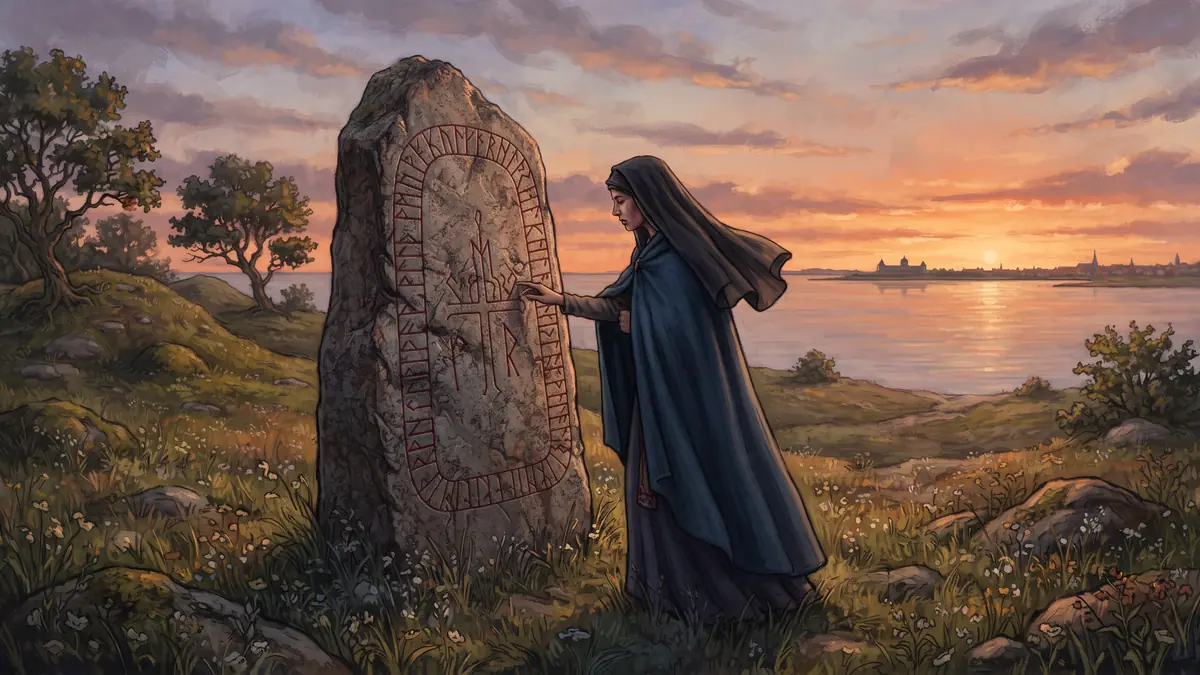
Many runestones say only who had them raised and in memory of whom. The one at Karlevi, on Öland, says more: it carries a stanza of poetry. Wikipedia states that it is a complete stanza, the only one preserved on a runestone, and the oldest record of a skaldic stanza.
The stone
The Karlevi stone (Öl 1) stands near the Kalmar Strait, at Karlevi, on the island of Öland in Sweden. It is granite, 1.4 metres tall, and of the RAK style, with bands of straight runes without dragon or serpent heads. It is usually dated to the late tenth century.
The prose text
The prose part names Sibba, called “Goða”, son of Fuldar. The stone is thought to have been raised in memory of a lord, perhaps by warriors who fought in the battle of Fýrisvellir, which is contemporary.
The stanza
The verse part is in dróttkvætt, the “lordly metre”, the most famous form of skaldic poetry. Wikipedia gives a literal translation, which I summarize here in my own words: the man lying in this mound was followed by great deeds, as most people knew. He is described as a “tree of Þrúðr’s battles”, that is, a warrior. The stanza then says that a Viðurr (a name of Odin) of the wide sea, more upright and strong in strife, a sea-warrior, will not rule land in Denmark. The meaning of this reference to Denmark is not clear.
The kennings
The poem uses the names of two gods as images for “chieftain”. Þrúðr is a daughter of Thor, and Viðurr is a name of Odin. This is typical of the skaldic style: instead of saying “warrior”, the poet composes a circumlocution with a god.
The back of the stone
On the other side there is an inscription that is not runic, possibly “In nomin[e] Ie[su]”, that is, “In the name of Jesus”. There also seems to be a small Christian cross and a hammer of Thor, Mjöllnir. The stone thus brings together symbols of the two religious worlds of the time.
What remains open
Wikipedia lists the works on the stone, from Söderberg in 1900–1906 to Thunberg in 2012 and Zilmer in 2005. Among the points without an answer are what the mention of Denmark means, who exactly the man in the mound was and whether the stone was really raised by men who fought at Fýrisvellir.
In short
The Karlevi stone, on Öland, dates from the late tenth century and carries a complete skaldic stanza, with two kennings (Þrúðr and Viðurr), the oldest skaldic stanza on record. The back has a possibly Christian inscription and a hammer of Thor. Much of the poem is still debated by scholars.
To match each phrase to its part of the stone, play Every phrase in its part.
Sources.
- English Wikipedia, article "Karlevi Runestone" (Öl 1), with the inscription, the translation and the references
- Rundata (Scandinavian Runic Text Database), entry Öl 1, cited on Wikipedia
- Judith Jesch, Ships and Men in the Late Viking Age (2001), and Peter Foote and David M. Wilson, The Viking Achievement (1989), cited on Wikipedia