 MMXXVI
The Master-Smith: the Norwegian tale of the smith who trapped the devil in a pear-tree, a chair and a steel purse
In the tale "The Master-Smith", by Asbjørnsen and Moe in Dasent's translation, a smith who made a bargain with the devil is granted three wishes by Our Lord and uses them all against the devil. See the sequence: the forge, the pear-tree, the chair, the steel purse, the nine locks and the hammer at heaven's gate.
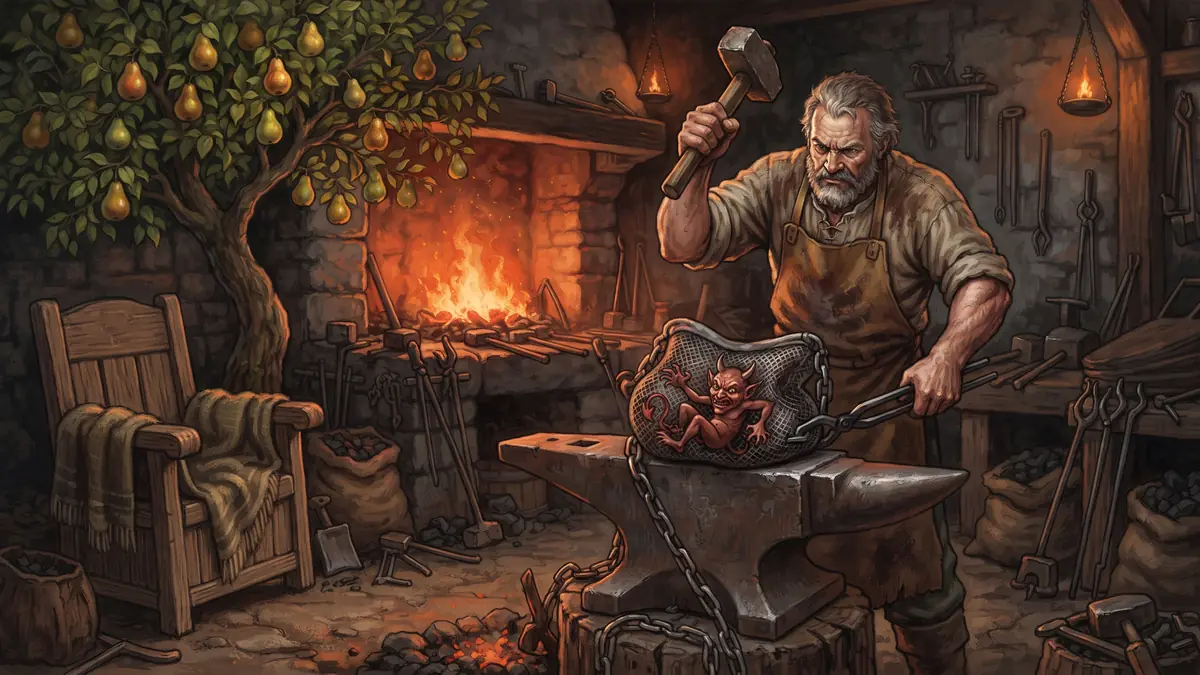
A smith who thinks himself master over all masters, three badly chosen wishes and a devil caught in a purse. It is “The Master-Smith”, a tale that Asbjørnsen and Moe collected in Norway.
The bargain and the sign
Our Lord and St Peter wander the earth and reach a smith’s house. The smith has made a bargain with the devil: after seven years the devil will take him, but until then he will be master of all masters in his trade. Over his door he has written “Here dwells the Master over all Masters”.
Our Lord goes in and asks who he is. The smith tells him to read the sign. A man brings a horse to be shod, and Our Lord offers to do it. He shoes all four legs perfectly. The smith admits: “You’re not so bad a smith after all.”
The old woman in the furnace
The smith’s old mother calls him to dinner. Our Lord puts her in the furnace and makes a young maiden of her. The smith says he has learned something and that “one learns as long as one lives”.
After dinner the smith tries the same with a horse. The legs burn to ashes, and he pays for the horse. He then puts an old beggar-woman in the furnace, and she dies.
The three wishes
Our Lord says: “That was ill done.” And he offers the smith three wishes. The smith wishes that anyone he asks to climb his pear-tree, sit in his easy chair or creep into his steel purse must stay until released. St Peter says he wished as a wicked man and should have asked for God’s grace.
The devil trapped
Years pass and the devil comes for the smith. The smith asks the devil to wait in the pear-tree while he hammers a nail-head, and keeps him there for four years, until he extracts a promise not to return before then.
The devil returns and is seated in the easy chair while the smith “sharpens the point” for another four years. The devil again promises to wait.
The third time, the smith asks whether the devil can really shrink himself. The devil creeps into the steel purse, and the smith welds it shut and beats it on the anvil until the devil begs to be released and promises never to return.
Heaven or hell
Later the smith worries that heaven may refuse him and hell may be closed to him after his quarrel with the devil. He decides to try hell first. At a crossroads he meets a tailor with a goose, bound for heaven.
At the gates of hell, the devil orders all nine locks and a padlock fastened, fearing the smith will “turn hell topsy-turvy”.
The smith goes on to heaven. St Peter opens the gate just enough for the tailor to slip in. The smith hurls his sledge-hammer into the gap and gets in after him.
Dasent’s introduction
In the book’s introduction, Dasent describes the end of the tale: the smith, having quarrelled with the devil, is sent to hell, where the devil orders the watch to lock all the nine locks on the gates.
What the tale does not say
The text does not tell what happens to the smith after he gets into heaven. The end is the moment the hammer goes through the gap.
In short
It is a tale of cunning in which the smith, proud and careless at first, uses the wishes to beat the devil three times. What the tale leaves open is whether the smith really deserved to get into heaven.
To train your attention with the pear-tree, the chair and the steel purse, play The master’s hammer.
Sources.
- Peter Christen Asbjørnsen and Jørgen Moe, tale in George Webbe Dasent's English translation, "The Master-Smith", in Popular Tales from the Norse (Project Gutenberg)
- Dasent's introduction in the same book, which cites the end of the tale and the nine locks of the gates of hell