 MMXXVI
The Seven Foals: the Norwegian tale of the lad in the ashes who ran after seven foals and broke a troll's spell
In the tale "The Seven Foals", by Asbjørnsen and Moe in Dasent's translation, the king promises his daughter to whoever watches seven foals for a day. Two brothers fail with an old woman in a rock cleft, and the youngest follows the foals, drinks from a pitcher and brings the bread and wine from the church. See the sequence.
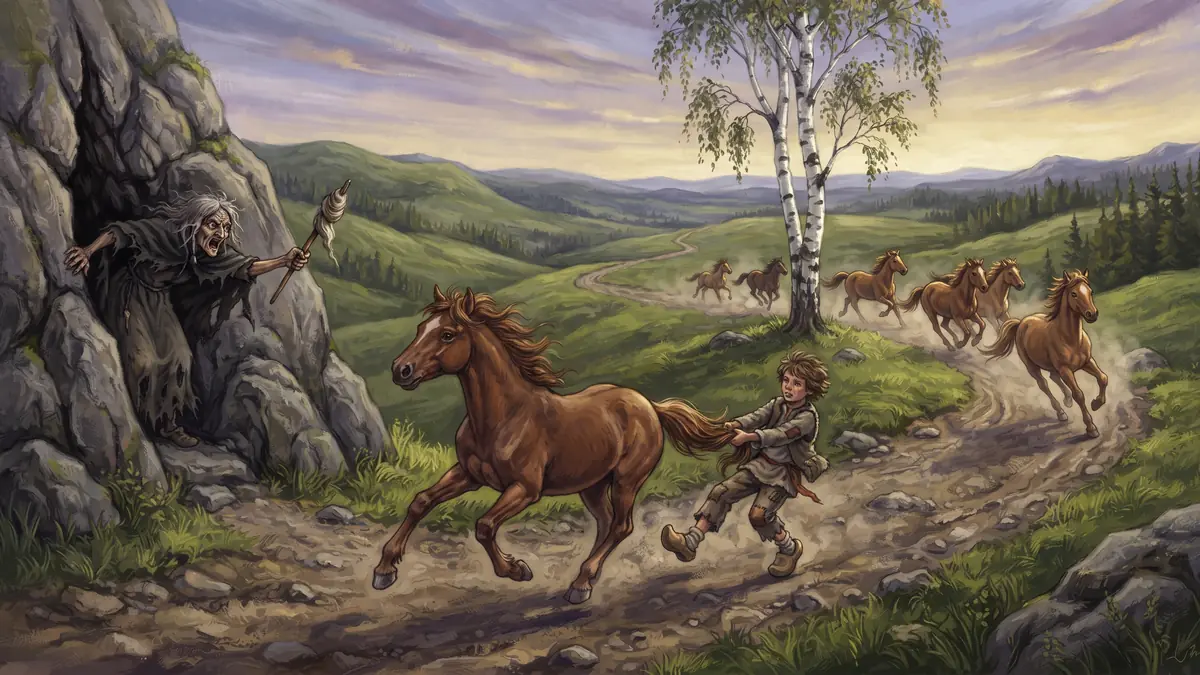
Seven foals, an old woman who combs hair and a rusty sword that can be lifted only after three sips. That is the plot of “The Seven Foals”, one of the tales of Asbjørnsen and Moe that Dasent translated into English.
The king and the foals
A poor couple live in a hut deep in the wood with three sons. The youngest, Boots, does little but lie about in the ashes.
The eldest son sets out to find work and reaches the king’s palace at evening. The king, standing on the steps, offers him a task: watch the seven foals for one whole day and say at night what they eat and drink. The reward is the princess and half the kingdom. Failure means three red stripes on the back.
The brothers
The next morning the coachman lets the foals out, and the lad runs after them over hill and dale. Tired, he reaches a cleft in a rock where an old woman sits spinning with a distaff. She calls: “Come hither, my pretty son, and let me comb your hair.” He lies with his head in her lap all day.
At evening she gives him a flask of water and a clod of turf to show the king as the foals’ food and drink. The king sees through it, and the lad is punished and sent home.
The second brother does the same and gets the same punishment.
Boots
The brothers mock him, but Boots insists. The king says he is no better than the others. Boots replies that he has come far and may as well try. The king says he may try if he is willing to have his back flayed. Boots says: “I’d much rather have the Princess.”
At dawn the foals bolt. When the old woman calls to him, Boots taunts her: “Don’t you wish you may catch me”, and keeps running, holding on to a foal’s tail.
The sword and the pitcher
Past the cleft, the youngest foal tells Boots to climb onto its back. They ride a long way, and the foal asks again and again: “Do you see anything now?” At last Boots sees something white, like a tall birch trunk. The foals go into it. The eldest pushes the trunk aside, and a door appears, with a small room behind it holding a fireplace, a bench or two, a rusty sword and a small pitcher.
The foals tell Boots to try the sword. He cannot wield it at first, so they make him drink from the pitcher, once, twice, three times. After that he wields it easily.
The foals’ secret
The foals explain that they are the princess’s brothers, under a troll’s spell. Boots must cut off all seven heads with the sword on his wedding day and lay each one at the tail of the body it came from, to break the spell. He promises.
The church
They ride on, cross a river by a long grand bridge, and Boots sees a dark shape like a church steeple. In the churchyard the foals become princes in fine clothes. They go into the church and take bread and wine from the priest, who blesses them. Boots also goes in and, after the service, takes a flask of wine and a wafer with him. Outside, the princes turn back into foals.
The return
Boots mounts the youngest foal, and they race back past the bridge, the trunk and the old woman, who screeches with rage as they pass. Near dark they reach the palace. The king asks whether he watched well. Boots produces the wine and the wafer as the foals’ food and drink. The king accepts, promises him the princess and half the kingdom and orders a grand wedding.
The wedding
At the feast the bridegroom excuses himself, goes to the stable and beheads all seven foals, the eldest first, laying each head at the tail of its foal. The seven become princes again.
The king is overjoyed. He gives Boots the other half of the kingdom after his death. The narrator, who was there, complains of getting only burnt bread and butter and not a crumb.
In short
It is a tale of three tries. The first two fall into the old woman’s trap, and the third wins by not stopping. The answer to the king’s riddle is not to find out what the foals eat, but to bring proof from the church.
To train your attention with the foals, the pitcher and the birch trunk, play Boots gallops with the foals.
Sources.
- Peter Christen Asbjørnsen and Jørgen Moe, tale in George Webbe Dasent's English translation, "The Seven Foals", in Popular Tales from the Norse (Project Gutenberg)
- Dasent's introduction in the same book, which says the foals are princes under a spell cast by a witch or troll to whom an unwary promise was given