 MMXXVI
The Three Aunts: the Norwegian tale of the girl who spun, wove and sewed without working
In "The Three Aunts", a tale by Asbjørnsen and Moe, a poor girl is helped by three strange old women to spin, weave and sew. Each asks only one thing: to be called aunt. See what each aunt does and how the prince reacts.
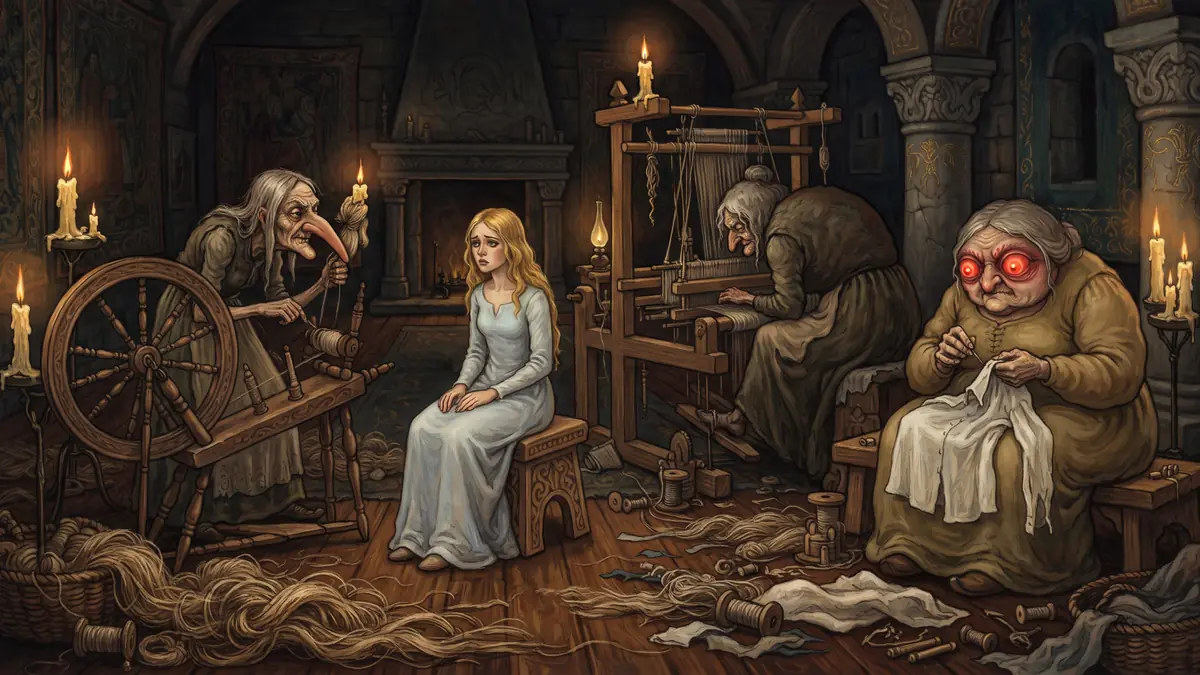
In a world where every family made its own cloth, spinning, weaving and sewing were endless work. The tale “The Three Aunts”, collected by Asbjørnsen and Moe and translated by Dasent, starts from that weight. And it has a curious answer to it.
The girl at the palace
A poor hunter’s daughter goes out into the world to earn her bread and finds a place at the palace. The queen likes her so well that the other maids grow envious. They tell the queen that the girl boasts she can spin a pound of flax in twenty-four hours, which she has never done.
Shut in a room with the flax, the girl weeps. That is when an old woman appears.
The three aunts
The first old woman offers to spin the flax if the girl will call her aunt on the happiest day of her life. The yarn is finer than anyone has seen. This aunt has a very long nose, and says it grew from sitting, poking and nodding over her spinning.
On the next task, weaving the yarn into linen, a second old woman appears and makes the same bargain. The linen comes out so good that no weaving could be better. She has a broad, humped back, from scuttling back and forth at her loom.
On the third task, making up the linen into shirts, a third old woman proposes the same bargain. The shirts are beautifully sewn and already marked. She has red, bleared eyes, as large as saucers, from staring and sewing night and day.
The wedding
The queen is delighted and offers the girl the prince as a husband, since she can do all the work herself. At the feast, each aunt arrives, and the bride greets her with “Good-day, Auntie!” The prince asks whether they are really his bride’s aunts. Each says yes, and he invites each to sit down to the feast, though he and the guests find them loathsome.
Later the prince asks how such a lovely bride can have such misshapen aunts. Each explains that her deformity came from her own work. The prince concludes that if work makes folk so ugly, his bride shall never spin, weave or sew again.
A tale about crafts
Each aunt matches one stage of working flax and one mark on the body: the one who spins has the long nose, the one who weaves has the humped back and the one who sews has the red eyes. It is a way of keeping the order and of saying that each craft leaves its signs on the one who practises it.
In short
“The Three Aunts” is a Norwegian tale by Asbjørnsen and Moe, in Dasent’s translation. A poor girl is helped by three old women, one who spins, one who weaves and one who sews, and each asks only to be called aunt. In the end, seeing the marks of work on them, the prince decides his bride shall never spin, weave or sew again.
To match each aunt to her craft, play Each aunt her craft.
Sources.
- Asbjørnsen and Moe, "The Three Aunts", in Popular Tales from the Norse, translated by George Webbe Dasent, Project Gutenberg no. 8933