 MMXXVI
The Three Princesses of Whiteland: the tale of the boat, the troll and the three treasures
A Norwegian tale from Asbjørnsen and Moe, translated by Dasent: a lad frees three princesses buried up to their necks, loses his wife and wins her back with a hat, a cloak and boots. See the plot and the sources.
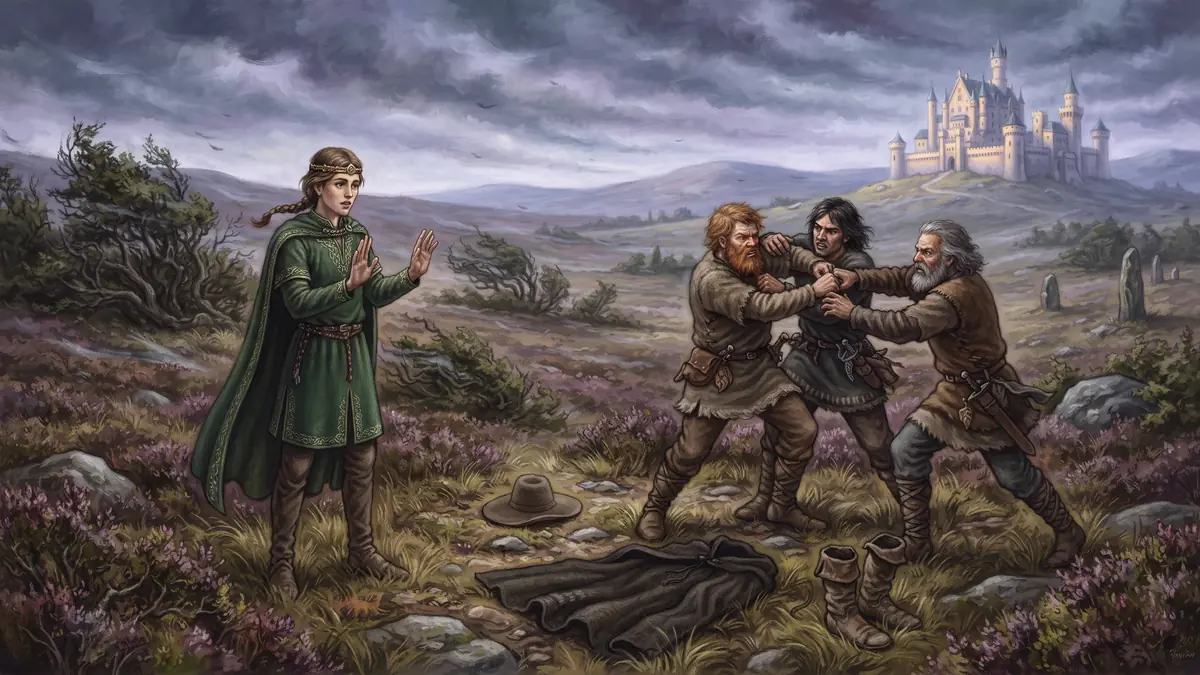
Among the Norwegian folktales collected by Asbjørnsen and Moe there is one in which a lad sets out in a boat and reaches a white land. “The Three Princesses of Whiteland” is known mainly through George Webbe Dasent’s English translation. This text follows that version.
The bargain
A fisherman who supplies the king’s table catches nothing, until a head rises from the water and offers him plenty of fish in exchange for what his wife carries under her girdle. He agrees without knowing she is pregnant. The king hears of it, promises to look after the child and raises the boy as his own son.
Whiteland
Grown, the lad goes fishing with his father. He goes back to the boat for a forgotten handkerchief, and the boat carries him through the night to a white shore. An old bearded man tells him that farther on three princesses stand buried to their necks. The first two will beg for help, and he must ignore them. The third he must help.
The three nights
Three trolls buried the princesses. To free them, the lad must endure a whipping, one night for each princess. Two lions guard the gate, and he walks between them unharmed. In a small dark room he lies down and lets the troll beat him. On the wall hang a flask of ointment and a sword.
On the first night comes a three-headed troll with three rods, and the princesses rise to their waists. On the second, a six-headed one with six rods, and they rise to their knees. On the third, a nine-headed one. The lad faints, the troll dashes him against the wall, the flask falls, breaks and spills the ointment over him, and he is healed and kills the troll. The princesses are free, and he chooses the youngest as his queen.
The ring and the mistake
Before visiting his parents, the queen gives him a ring that grants two wishes and makes him promise to follow his father’s wishes, not his mother’s. His mother wants him to show off at the palace, his father objects, and he goes. The other king mocks the queen’s looks. The young king wishes she were there, and she appears. She rebukes him for breaking his promise, knots a ring with her name into his hair and wishes herself home. Both wishes are gone.
The search
The king looks for Whiteland. The lord of the beasts calls his animals with a horn, but none know the way, and he gives the king a pair of snow-shoes. The lord of the birds calls the birds, and only an old eagle, away for ten years, comes, and gives the second pair. The lord of the fish calls the fish. An old pike, who spent ten years as a cook in Whiteland, tells him that the queen, whose husband is away, is about to remarry.
The hat, the cloak and the boots
The pike tells of three brothers who have fought for centuries on a moor over a hat, a cloak and a pair of boots. Whoever holds all three becomes invisible and can wish himself anywhere. The king offers to judge their dispute, takes the three items and wishes himself away.
The end
Flying toward Whiteland, the king meets the North Wind, who tells him to wait on the castle stairs: the wind will storm in, the suitor will come out, and the king should throw him out by the collar. The queen does not recognize him, he is so thin. When he shows her the ring, she knows him, and the wedding takes place.
In short
The tale joins a pact with a creature of the water, three nights of trial, a broken promise and a quest that ends with three magic objects. The details here are those of Dasent’s version, and other Norwegian versions may vary.
To repeat the sequence of the three treasures without a mistake, play The hat, the cloak and the boots.
Sources.
- Peter Christen Asbjørnsen and Jørgen Moe, Norske Folkeeventyr
- George Webbe Dasent, Popular Tales from the Norse, "The Three Princesses of Whiteland" (English translation)
- English Wikipedia, article "The Three Princesses of Whiteland", for the tale-type classification